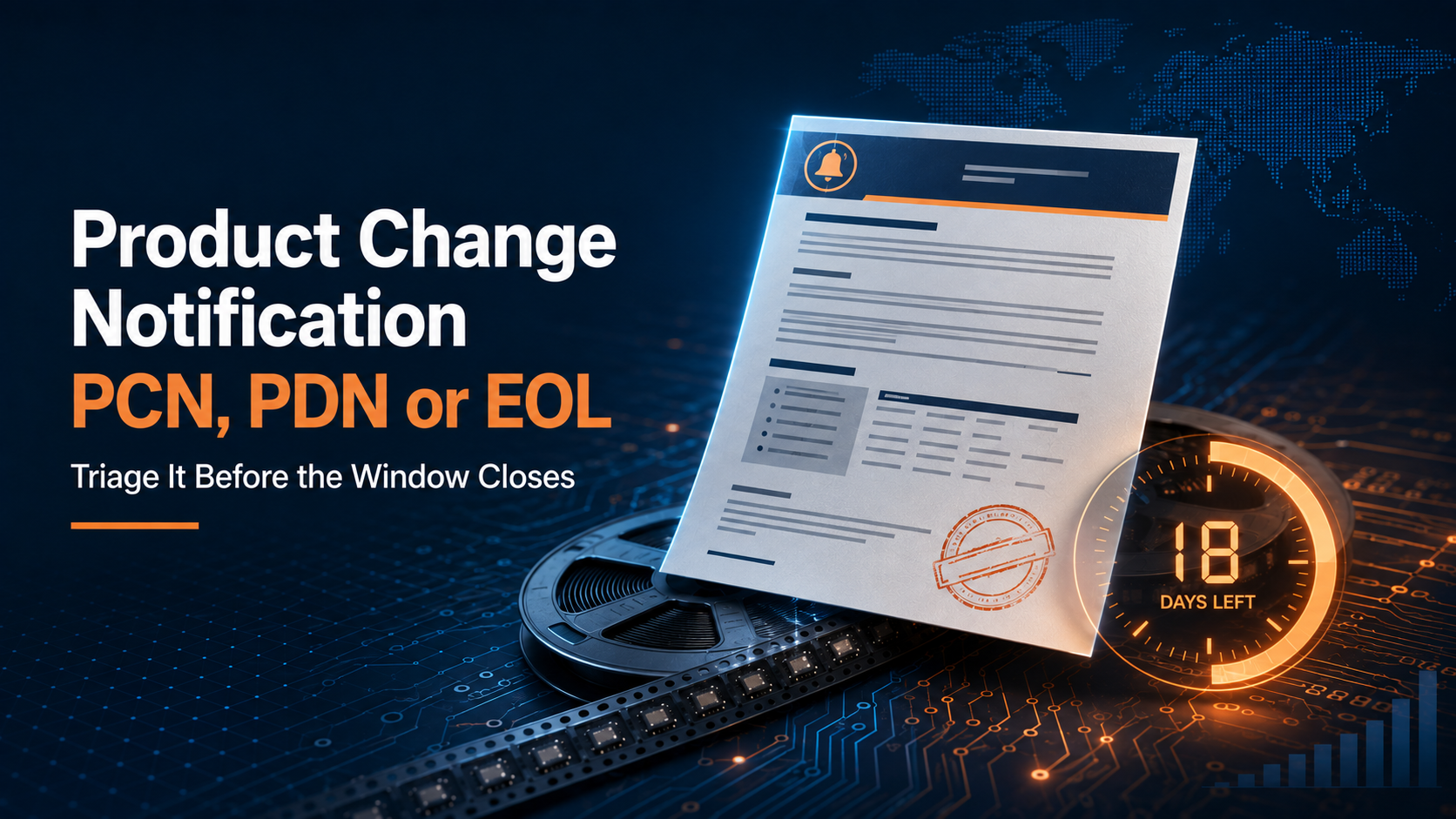
A product change notification (PCN) is a manufacturer's formal warning that something about a part you already designed in is about to change. Under J-STD-046, the supplier must issue it at least 90 days before the first shipment of the changed part, and you are asked to acknowledge it within 30 days. Here is the part most buyers miss: failing to acknowledge a PCN within that window counts as accepting the change. Silence is a reply. If a PCN is sitting unread in a shared purchasing inbox, your company has already said yes.
This guide covers what a PCN, a PDN and an EOL notice actually are, the clocks each one starts, why the notice often never reaches you at all, and a triage workflow you can run on the day it lands.
PCN, PDN and EOL: three notices, three different clocks
These three terms get used interchangeably in day-to-day sourcing conversations, and that is where expensive mistakes start. A PCN is not automatically an obsolescence event. A PDN always is.
| Notice | What it means | Governing standard | The clock it starts | Your decision |
|---|---|---|---|---|
| PCN Product Change Notification |
The part continues, but something about it changes: package, die, assembly site, material set, test flow or datasheet parameters. | J-STD-046 (replaced JESD46 in 2016) | Minimum 90 days before first shipment of the changed part. Acknowledge within 30 days. | Requalify, accept, or buy pre-change date codes while they last. |
| PDN Product Discontinuance Notice |
The part is being withdrawn from production. Also issued as a PTN or discontinuance notice. | J-STD-048 (replaced JESD48 in 2014) | 6 months from notice to the last order date, 12 months to the last ship date. | Size and place a last-time buy, or start a redesign. |
| EOL End of Life |
A lifecycle status, not a document. The part has reached the end of its production life. | No standard, it is a state | None. By the time a part is labelled EOL the notice clocks have usually run out. | Source from surplus and independent stock, or requalify an alternate. |
The practical difference: a PDN gives you a hard, dated purchase window of roughly six months. A PCN gives you a 90 day technical review window and no guaranteed stock of the old version at all. Buyers who treat every notice as "an EOL thing for the obsolescence team" routinely burn the PCN window doing nothing.
Why the notice may never reach you
The notification obligation runs down the franchised channel. The manufacturer notifies its authorised distributors and its direct contract customers. That is it. Three common situations leave you with no notice at all:
- You buy through a contract manufacturer. The PCN goes to the EMS provider's purchasing system, not to your design team. Whether it reaches you depends entirely on your supply agreement.
- You buy on the open market. Surplus, brokered and independent stock carries no notification relationship. This is a genuine trade-off of open-market sourcing, and it is worth weighing alongside the other differences between a franchised and an independent distributor.
- Nobody registered. Most manufacturer PCN portals are opt-in per part number and per email address. If the engineer who registered has left the company, the subscription left with them.
There is also a growing category of parts that reach end of life with no notice issued at all, usually low-volume legacy lines from suppliers who no longer track who is buying them. That is why an obsolescence programme cannot be built on inbound notices alone. It needs periodic lifecycle screening of the whole bill of materials, which is the discipline covered in our electronic component obsolescence management guide and our BOM evaluation guide.
A five-step PCN triage workflow
Run this the day the notice arrives, not the week before the last order date.
1. Log it and stop the acceptance clock (day 1)
Record the notice number, issue date, affected part numbers, change category, effective date, last order date and last ship date. Send the acknowledgement immediately, even if your technical answer is weeks away. Acknowledgement is not agreement to the change, but silence is treated as agreement to it.
2. Establish real exposure (days 1 to 3)
A PCN usually lists a whole part family. Match it against your live BOMs, not your part master. You need three numbers: annual usage, current on-hand plus in-transit stock, and how many months of production that covers. Without those three you cannot size anything in step 4.
3. Classify the change (days 3 to 10)
Not every change matters equally to your product:
- Form, fit or function change (pinout, package dimensions, electrical parameters): highest risk, always requires requalification.
- Assembly or fabrication site transfer: no datasheet change, but date code traceability and the underlying qualification data set both change. Automotive and medical programmes normally treat this as a full requalification trigger.
- Die revision or shrink: parametrics stay within datasheet limits, but real-world behaviour such as timing margin, ESD performance and current draw can shift.
- Material set or moisture sensitivity change: can change your reflow profile and floor life handling.
- Regulatory or exemption change: a RoHS exemption expiring for a specific part is a common and easily missed PCN trigger.
4. Choose the response (days 10 to 30)
There are only four real answers, and cost separates them sharply:
- Accept the change. Cheapest. Correct for most non-critical passives and jellybean logic.
- Requalify. Weeks of engineering time plus test. Correct when the part sits in a safety, automotive or certified assembly.
- Bridge buy pre-change stock. Buys time to requalify without stopping the line. Requires date code control on incoming goods.
- Move to an alternate. The right call when the part was already at risk. See our guides on second sourcing electronic components and, for a discontinuance, last-time buy strategy.
5. Execute before the window, not on it
Last order dates are not soft. Authorised stock allocated against a discontinued line is typically consumed well before the published date, because every customer holding the same notice is buying at the same time. Treat the last order date as the point at which the part is already gone, and place your order a clear margin ahead of it.
When the window has already closed
Most companies discover a PCN after the fact: a delivery arrives with a different date code, or a new build behaves differently on test. At that point the franchised channel has nothing, and the part moves to open-market and surplus supply.
This is workable and routine, but the risk profile changes. Discontinued and obsolete parts are the most heavily counterfeited category in the industry, precisely because demand persists after legitimate supply ends. Buying here means insisting on documented traceability, a certificate of conformance, and inspection proportionate to the risk. Our guides on sourcing obsolete electronic components and avoiding counterfeit components cover those controls in detail.
How GlobX helps
GlobX sources components for European OEM and EMS teams, including the parts that sit on the wrong side of a last order date. If a PCN or PDN has landed on a part you are still building with, send us the notice number, the affected part numbers and your annual usage. We will come back with what is realistically available across the franchised and independent channel, at what lead time, and with what documentation. Get in touch and we will quote within 24 hours.
Für deutschsprachige Einkäufer: unser Leitfaden Obsolete elektronische Bauteile beschaffen zeigt Schritt für Schritt, was nach einer EOL-Mitteilung zu tun ist.