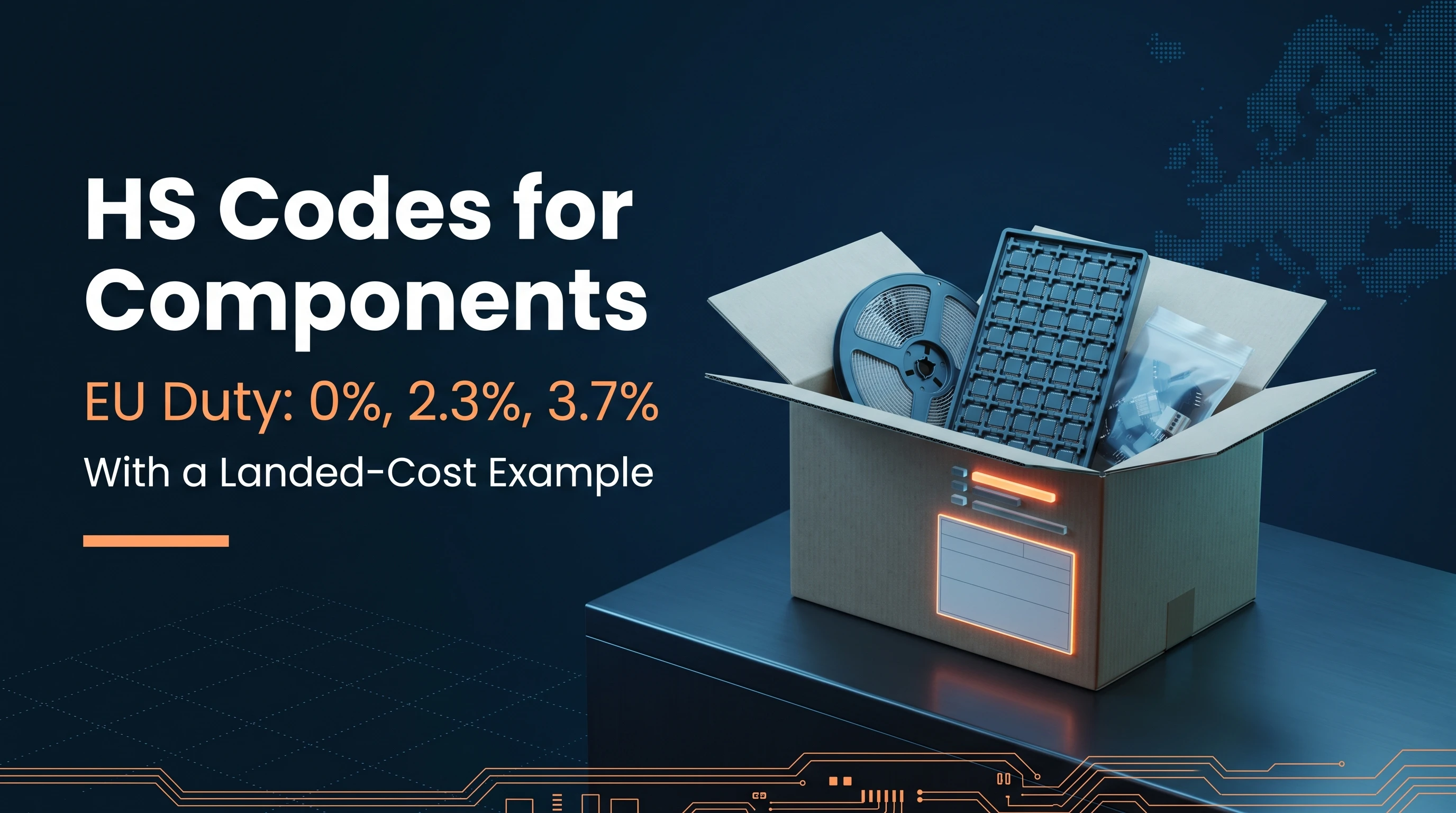
Most electronic components enter the EU duty-free. As of October 2026, the EU TARIC tariff applies a 0% third-country duty to integrated circuits (HS 8542), diodes, transistors and LEDs (8541), capacitors (8532), fixed resistors (8533) and bare printed circuit boards (8534). The parts that actually cost duty are the electromechanical ones: connectors and relays at 2.3% (8536), and cable assemblies and power supplies at 3.7% (8544, 8504). Import VAT, 19% in Germany, applies to all of them, so the real cost of a wrong HS code is rarely the duty itself. It is the held parcel, the courier's clearance fee and a recovery notice that can arrive years later.
This guide works through one real import first, then gives the code-by-code rates, then covers the places where buyers and suppliers get classification wrong.
One €5,000 Order, Three HS Codes: A Worked Landed-Cost Example
A €5,000 component order shipped from outside the EU pays about €28 in customs duty and about €984 in import VAT when it holds an MCU, an MLCC and a connector, because only the connector line is dutiable. Here is the calculation, using three parts that GlobX stocks in Europe.
Assume a German EMS company imports this order from a non-EU supplier, with €150 freight to the EU border:
- STM32H743VIT6 (STMicroelectronics Arm Cortex-M7 microcontroller, LQFP100): €3,000. Classified under 8542 31 (processors and controllers). Duty 0%.
- Murata KCM55V5C3A443JDL2L (multilayer ceramic capacitor, metal terminal type): €800. Classified under 8532 24 (ceramic dielectric, multilayer). Duty 0%.
- Molex 1042470617 (0.5 mm pitch FFC/FPC connector, 6 positions): €1,200. Classified under 8536 69 (plugs and sockets). Duty 2.3%.
Step 1, customs value. The EU values imports at the transaction price plus transport and insurance up to the point of entry into the EU. That makes €5,150 here. The freight is split across the lines in proportion to value, so the connector line carries €36 of it (1,200 / 5,000 x 150).
Step 2, duty. Only the connector line is dutiable: (€1,200 + €36) x 2.3% = €28.43. The MCU and MLCC lines pay nothing.
Step 3, import VAT. German import VAT is charged on the customs value plus the duty: (€5,150 + €28.43) x 19% = €983.90. A VAT-registered business recovers this as input VAT, so it is a cash-flow cost, not a final cost.
Step 4, the costs nobody puts in the spreadsheet. The courier or forwarder charges a clearance or disbursement fee for lodging the declaration and advancing the VAT. Buyers on electronics forums regularly report flat fees of around €20 per shipment, charged even when the duty is zero. On a €5,000 order that is noise. On ten €300 sample orders a month it is €200 of pure overhead.
The practitioner gotcha: if the supplier's commercial invoice lists all three lines as "electronic components, HS 8542", the declaration is wrong for the connector. Customs can post-audit it and recover the underpaid 2.3% within the three-year limit set by the Union Customs Code, from the importer of record, not from the supplier. The money is small. The audit trail of a misdeclared import is not.
EU Import Duty Rates by Component Type (as of October 2026)
The table below gives the EU third-country ("erga omnes") conventional duty for the headings that cover a typical BOM, checked against the EU's TARIC database in October 2026. Rates can change, so confirm the full 10-digit code in the EU TARIC consultation tool before you file.
| Component family | HS subheading | EU third-country duty | Typical parts |
|---|---|---|---|
| Processors and controllers | 8542 31 | 0% | MCUs, MPUs, DSPs |
| Memories | 8542 32 | 0% | DRAM, NAND, NOR flash, EEPROM |
| Amplifiers | 8542 33 | 0% | Op-amps, RF amplifier ICs |
| Other integrated circuits | 8542 39 | 0% | FPGAs, interface ICs, PMICs, ADCs |
| Diodes | 8541 10 | 0% | Rectifiers, Schottky, TVS, Zener |
| Transistors | 8541 21 / 8541 29 | 0% | MOSFETs, BJTs, IGBTs |
| Thyristors, triacs | 8541 30 | 0% | SCRs, triacs, diacs |
| LEDs | 8541 41 | 0% | Indicator and power LEDs |
| Mounted crystals | 8541 60 | 0% | Quartz crystals, resonators |
| Fixed capacitors | 8532 21 to 8532 25 | 0% | Tantalum, aluminium electrolytic, MLCC, film |
| Resistors | 8533 10 to 8533 40 | 0% | Chip resistors, wirewound, potentiometers |
| Bare printed circuits | 8534 00 | 0% | Unpopulated PCBs, multilayer boards |
| Relays | 8536 41 | 2.3% | Signal and power relays up to 60 V |
| Plugs, sockets, connectors | 8536 69 | 2.3% | Board-to-board, FFC/FPC, headers |
| Cable assemblies with connectors | 8544 42 | 3.7% (0% for telecom types) | Harnesses, ribbon cable assemblies |
| Power supplies and converters | 8504 40 | 3.7% on most subheadings | AC-DC modules, DC-DC bricks, LED drivers |
The pattern behind the zeros is the WTO Information Technology Agreement, which removed duties on semiconductors and passive components. Electromechanical parts and power conversion fell outside it, which is why a BOM that looks "all electronics" still produces a duty line. If your annual imports of connectors and relays reach six figures, that 2.3% is a number worth putting in front of your purchasing manager.
Why "Electronic Parts" on an Invoice Gets a Shipment Held
A parcel described only as "electronic parts" or "spare parts" is the most common reason a component shipment stops at customs, because the officer cannot assign a code from that wording and has to ask. Every query adds one to three working days and usually a courier handling charge.
Three invoice fixes prevent most holds:
- One line per HS subheading, with the manufacturer part number. "STM32H743VIT6, microcontroller, 8542 31" clears. "IC chips, 500 pcs" invites a question. The full ordering code matters because suffixes change the product: our part number suffix decoder shows how packaging and grade codes sit at the end of an MPN.
- Country of origin per line. The origin printed on a reel label is often the assembly and test site, not the wafer fab. Use what the manufacturer documents, and keep the certificate of conformance with the shipment file.
- Real unit prices. Undervalued sample invoices ("value for customs: €5") are a classic trigger for a valuation query, and the EU applies the VAT to the corrected value anyway.
Buyers who scrub the BOM before ordering catch most of this in one pass. The BOM scrubbing checklist already asks for MPN, lifecycle and compliance status per line; adding a commodity code column there costs five minutes per BOM.
Does the New €3 Small-Parcel Duty Apply to Component Orders?
The €3 flat duty that the EU introduced on 1 July 2026 applies only to business-to-consumer distance sales of parcels worth €150 or less, so a component order shipped to a VAT-registered company is not caught by it. Company imports are declared the normal way and pay the conventional rates in the table above.
The measure comes from Council Regulation (EU) 2026/382 and runs from 1 July 2026 to 1 July 2028, according to the European Commission's Access2Markets notice on the €3 duty. Two details matter for anyone who orders parts privately, for example an engineer buying prototype samples on a personal card from a marketplace seller:
- The €3 is charged per distinct tariff classification in the parcel, not per parcel. In a simplified H7 declaration the item is counted at the 6-digit HS level, so a €60 parcel holding one microcontroller (8542 31), a strip of MLCCs (8532 24) and two connectors (8536 69) carries three items and €9 of duty.
- The duty applies even when the goods' normal rate is 0%. That €9 is charged on a parcel whose chips and capacitors would otherwise enter duty-free.
For a company the practical rule is simple: route prototype and sample buys through a business account with the company's VAT ID and EORI number on the shipment, so they are declared as B2B imports.
Where Classification Goes Wrong: Modules, Boards and Kits
An integrated circuit stops being an 8542 product once it is mounted on a board with other components, so modules, evaluation kits and populated boards need their own classification by function. This is where supplier-assigned codes are most often wrong.
- Multi-component ICs stay in 8542. A package that combines silicon dies with passives inside one body (a multi-component integrated circuit, or MCO) is still classified as an integrated circuit under the Chapter 85 notes. Many power and RF devices fall here.
- Wireless and sensor modules leave 8542. A Wi-Fi or Bluetooth module on its own PCB with an antenna is typically classified as transmission apparatus or a part of it, and a sensor sold on a carrier board with signal conditioning is classified by what it measures. The rate can change with the move.
- Power modules split by design. A bare IGBT or MOSFET module made only of semiconductor dies in one housing is often classified as a semiconductor device under 8541, while modules that add gate drivers or control circuitry have been classified elsewhere, so check EBTI decisions first. An AC-DC power supply module with transformer, controller and output stage is a static converter under 8504 40 at 3.7%. Same bench, different code.
- Development boards are not components. An evaluation kit built around an MCU is classified by its function as a board, not as the chip on it. Do not let a supplier copy the IC's 8542 code onto the kit's line.
When a part sits on one of these borders and you import it repeatedly, apply for Binding Tariff Information (BTI). The EU's EBTI database also lets you search decisions already issued to other importers for similar products, which is the fastest way to see how customs authorities have treated a module before you file.
HS Code, ECCN and the Dual-Use List Answer Different Questions
An HS code decides what you pay at import; an export control classification decides whether you may ship at all. The two are unrelated, and a 0% duty line can still be a controlled item. A US ECCN on a datasheet tells you about US re-export rules, while EU export control runs on the Annex I entries of Regulation (EU) 2021/821, for which the Commission adopted an update in September 2026. Our guide to the EU dual-use list update for SiC and GaN parts walks through which power devices crossed into control. Keep both columns on your quote request: the HS subheading for customs and the control status for compliance.
What Changes When You Buy From Stock Already Inside the EU
Buying components from stock that is already in the EU removes the import declaration from your side entirely: the goods are in free circulation, so there is no customs value, no duty line and no courier clearance fee on your shipment. What remains is VAT. A German buyer purchasing from a German supplier pays 19% VAT on the invoice and reclaims it as input VAT. A VAT-registered buyer in France, Austria or the Netherlands buying from a German supplier receives a zero-rated intra-community invoice and accounts for VAT under the reverse charge in their own return. Both parties need valid VAT IDs, and the buyer files nothing with customs.
The trade-off is honest: EU stock is not always the cheapest unit price, and for 0% semiconductors the saving is mostly time and admin rather than duty. For connectors, relays and power supplies, and for anything you would otherwise buy in many small shipments, the landed-cost gap closes fast. It also helps to know who holds the stock: our comparison of franchised and independent distributors explains what traceability each channel can give you.
GlobX is based in Neu-Isenburg, Germany, and supplies OEM and EMS buyers across the EU. Send a BOM through our electronic component sourcing page and we quote every line with stock location and lead time, so you can see which parts arrive with no customs declaration on your side.