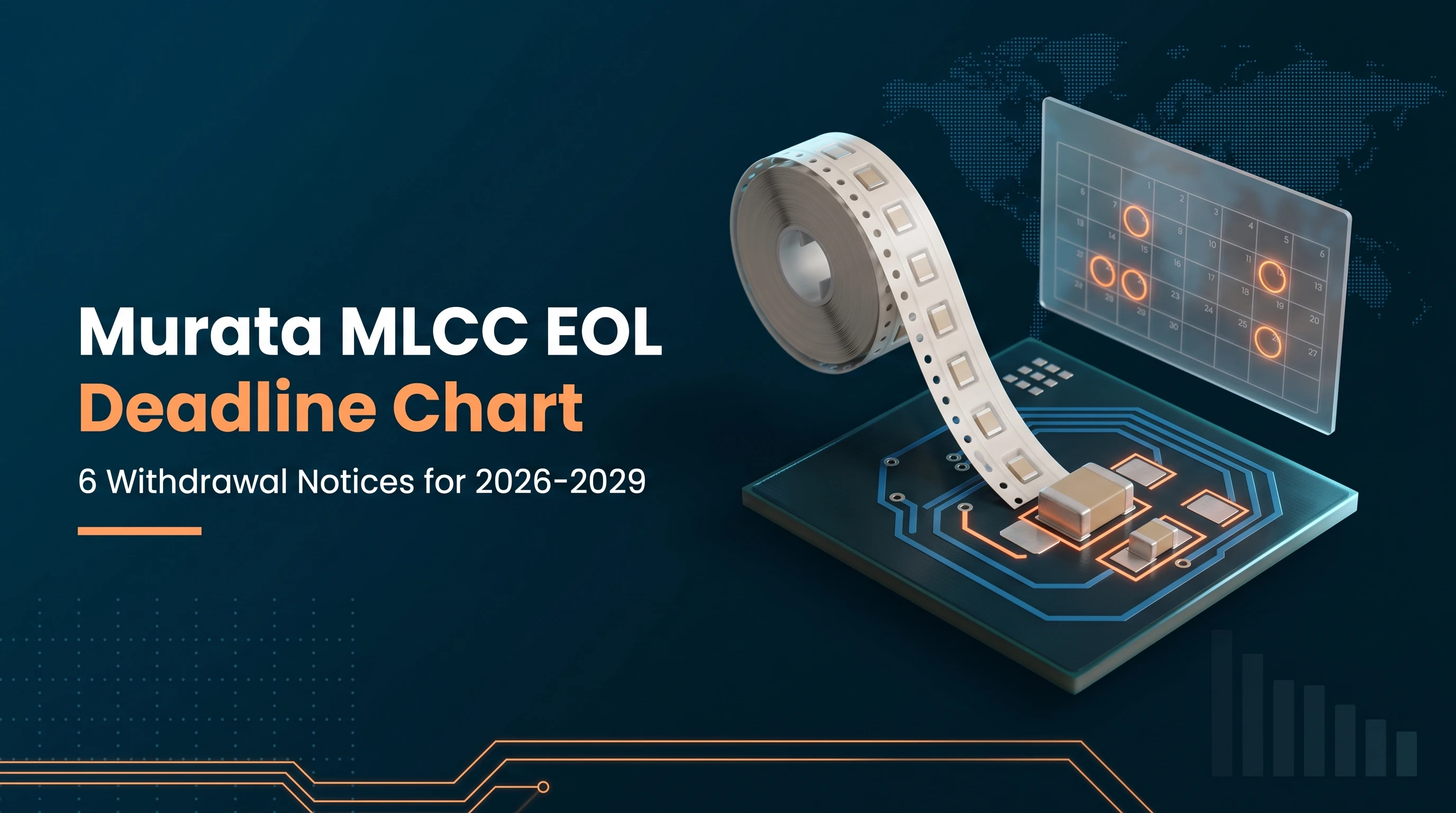
Murata has six product withdrawal notices with deadlines that are still open or only just closed, as of October 2026. Three cover multilayer ceramic capacitors (MLCCs) and three cover inductors and EMI filters. The deadline closest to most buyers is 31 December 2026. By then, customers holding large-case GRM, GRT or GCM capacitors under notice D08957 should have answered Murata in writing. The last time order date for those parts is 31 March 2027. A larger notice, reported in September 2026, covers selected part numbers in nine MLCC series and runs to a last order date of 31 March 2028.
Murata EOL notices 2025-2026: the deadline chart
The chart below lists every current Murata withdrawal with its scope and dates. We built it from the notices themselves where Murata's document was available, and from trade reporting where it was not. For each part, the notice attachment names the affected orderable part numbers. A series name in this table never means the whole series is ending.
| Notice | Products covered | Reply / approval due | Last time order | Last shipment |
|---|---|---|---|---|
| D09014 | Selected GRM, GRT, GJ8 and ZRA MLCCs | - | 30 Sep 2026 (closed) | 30 Sep 2027 |
| D08957 (issued Aug-Sep 2025) | Selected GRM, GRT and GCM MLCCs, size codes 32, 43 and 55 (1210, 1812, 2220), rated 100 V or less | 31 Dec 2026 | 31 Mar 2027 | 31 Mar 2028 |
| Nine-series notice (sent early Sep 2026, reported 10 Sep 2026) | Selected part numbers in GRM, GRJ, GRT, GXM, GXT, GCM, GCJ, GCG and ZRA | 31 Dec 2027 (reported) | 31 Mar 2028 | 31 Mar 2029 |
| D10102 (1-7 Aug 2026) | Various inductor and transformer series, plus AC/DC parts | - | 30 Sep 2027 | 31 Mar 2028 |
| D10162 (20 Aug 2026) | BNX block-type EMIFIL filters, no alternative offered | 30 Sep 2027 | 30 Sep 2027 | 31 Mar 2028 |
| D10157 (1 Sep 2026) | NFE chip EMIFIL LC combined filters | 30 Sep 2027 | 30 Sep 2027 | 31 Mar 2028 |
The common mode choke notice D08468 closed its last time order window on 31 March 2026, so it is not in the chart. If a broker offers you a part from that notice, treat it as excess stock and ask for full traceability. Murata has not published a notice number for the nine-series withdrawal. Its dates come from trade reporting, so confirm the dates for your own part numbers with your Murata sales contact before you plan around them.
Which Murata deadline is closest, and what happens if you stay silent?
The closest open deadline is 31 December 2026, about 11 weeks from mid-October. That is the acknowledgement date for D08957. Murata's notices treat silence as acceptance. The EMIFIL notices D10162 and D10157 both state that if Murata gets no reply by the due date, it assumes the notice "with all its contents has been accepted." Once that date passes, you lose the chance to tell Murata that a part is still in your production and needs a longer run or an agreed alternative.
The last time order date is binding in a different way. Each of the Murata notices we read states that Murata cannot accept orders after the Last Time Order Due date. Last time orders are also subject to minimum order quantity and package quantity. Murata accepts cancellations and returns only for a quality issue. In practice, a 7,300-piece requirement on a part packed in 10,000-piece reels becomes a 10,000-piece order you cannot cancel. Budget for the rounding before you place the order.
Murata's windows are generous by industry standards. JEDEC J-STD-048 sets a baseline of at least 6 months from a discontinuation notice to last order and 12 months to last shipment. D08957 gives roughly 19 months to last order. A long window is not a reason to wait, though. Automotive buyers need most of that time for requalification. For the general notice-to-LTB process, see our guide to product change notifications and EOL notices.
Why is Murata withdrawing these parts?
The notices give production reasons, not demand reasons. D09014 says Murata is ending the affected part numbers to stabilise MLCC supply and expand capacity for other products. The inductor notice D10102 cites low-volume mature part numbers with a shrinking customer base. D10162 points to falling orders and poor production efficiency. D10157 adds ageing production equipment that is difficult to replace.
The market context explains why this is happening now. A 1210 MLCC uses many times the ceramic volume of an 0402, so it ties up more material and furnace time per piece. That capacity is worth more in 2026, because AI server power boards are absorbing high-capacitance MLCCs. Murata, Samsung Electro-Mechanics and Taiyo Yuden were all running above 80% utilisation, as covered in our MLCC shortage 2026 report. Retiring low-volume part numbers frees lines for those higher-value parts. The same pressure means other suppliers have little spare capacity to absorb displaced volume quickly.
The gotcha: Murata's own alternative often changes the case size
A Murata-recommended alternative is often not a drop-in replacement. It is frequently a smaller case that needs a new footprint. The D08957 mapping table shows two examples:
- GRM32CR72A105KA35L (1210, X7R, 100 V, 1 µF) maps to GRM188D72A105KE01D (0603, X7T, 100 V, 1 µF).
- GRM32MR71H104KA01L (1210, X7R, 50 V, 100 nF) maps to GRM155R71H104KE14D (0402, X7R, 50 V, 100 nF).
Both swaps keep the capacitance value and the voltage rating. Neither keeps the land pattern. A 1210 pad cannot take an 0603 or an 0402 part, so the change needs a PCB revision, not just a BOM edit. The first example also moves from X7R to X7T. Over temperature, X7R holds capacitance within ±15%. X7T allows +22% to -33%. A smaller case at 100 V also usually loses more capacitance under DC bias. If the part decouples a 48 V rail, check the DC-bias curve before you approve it. If you cannot change the board, you need a cross-brand 1210 in the same dielectric. Our SMD package size chart shows which case-size moves are physically possible.
How to check whether a Murata part in your BOM is affected
Check your exact orderable part numbers against the notice attachments, including the final packaging letter. The series and size code are only a first filter. We use three passes.
- Exact-MPN match. Export every Murata line from the BOM with the full ordering code. Then match it against the attachment of each notice in the chart. A GRM part with packaging code D and the same part with code L are two different orderable numbers, and a notice can list one without the other.
- Series and size-code screen. For lines you cannot match yet, flag every GRM, GRT or GCM part with size code 32, 43 or 55 and a rating of 100 V or less. Those are the D08957 candidates. Do not flag a part just because its size code matches. GlobX stocks the Murata KCM55V5C3A443JDL2L (15,000 pieces, date code 20+, status active as of October 2026). Its size code is 55, but KCM is not one of the series named in D08957 or the nine-series notice. Matching on size code alone would have flagged it for nothing.
- Grade split. Separate the automotive series (GCM, GCJ, GCG) from the general series (GRM, GRJ, GRT, GXM, GXT). Automotive lines need an AEC-Q200 replacement and usually a PPAP update. This is why German automotive suppliers should start on them first. For how the AEC qualification families differ, see AEC-Q100 vs AEC-Q101.
Worked example: crossing a C0G 0402 to stock you can buy today
C0G MLCCs are the easiest to cross between brands. Their capacitance does not drift with DC bias, and the temperature behaviour is defined by the class. We use Murata GRM1555C1H330JA01D to walk through the method. We are not claiming this part is on a withdrawal list. Murata's reference sheet (specifications as of 14 June 2026) decodes it as 1005M (0402), C0G, 33 pF, DC 50 V, ±5%, rated -55 to 125 °C.
The cross-brand match is Yageo CC0402JRNPO9BN330. In Yageo's code, 0402 is the case size, J is ±5%, NPO is the same class-1 dielectric as C0G, 9 is 50 V and 330 is 33 pF. GlobX holds 189,000 pieces at date code 22+, factory-sealed with full labels, status active as of October 2026. For a board that uses four of these capacitors at 15,000 units a year, that covers three years of builds (180,000 pieces) while you qualify a long-term source.
Five fields must match: case size, dielectric class, capacitance, tolerance and voltage. Then check one more thing. Murata's GRM sheet limits the series to consumer, industrial, medical class A-C and automotive infotainment use. A cross-brand part needs the same or a higher application grade, never a lower one. Our cross reference checklist covers the remaining checks, such as termination finish and thickness.
Last time buy or switch now?
Place a last time buy when the remaining production run ends before about 2029 and a requalification would cost more than the stock you would carry. Switch now when the board will still be in production after the last shipment date, or when Murata's alternative already forces a layout change. Three decision rules we use with customers:
- Short-tail product (ends before 2028): buy the full remaining demand plus 10-15% scrap and yield allowance, rounded up to reel quantity, before 31 March 2027. Our last time buy strategy guide has the full formula.
- Long-tail product with a free footprint: qualify a cross-brand part in the same case size now. Then buy a bridge quantity from Murata only to cover the qualification months.
- Automotive line on GCM: reply to Murata before 31 December 2026, then run the AEC-Q200 replacement and the LTB in parallel. A rejected replacement found in 2027 leaves no order window to fall back on.
If you overbuy, the surplus still has value while these parts are scarce. Our guide on who buys excess electronic components explains how to recover cash from it. For a programme-level view, see the obsolescence management guide.
Send GlobX the Murata lines from your BOM, with quantities and the notice number if you have it. Within 24 hours we will return in-stock matches from EU stock, with date codes and the dielectric and grade checks already done.