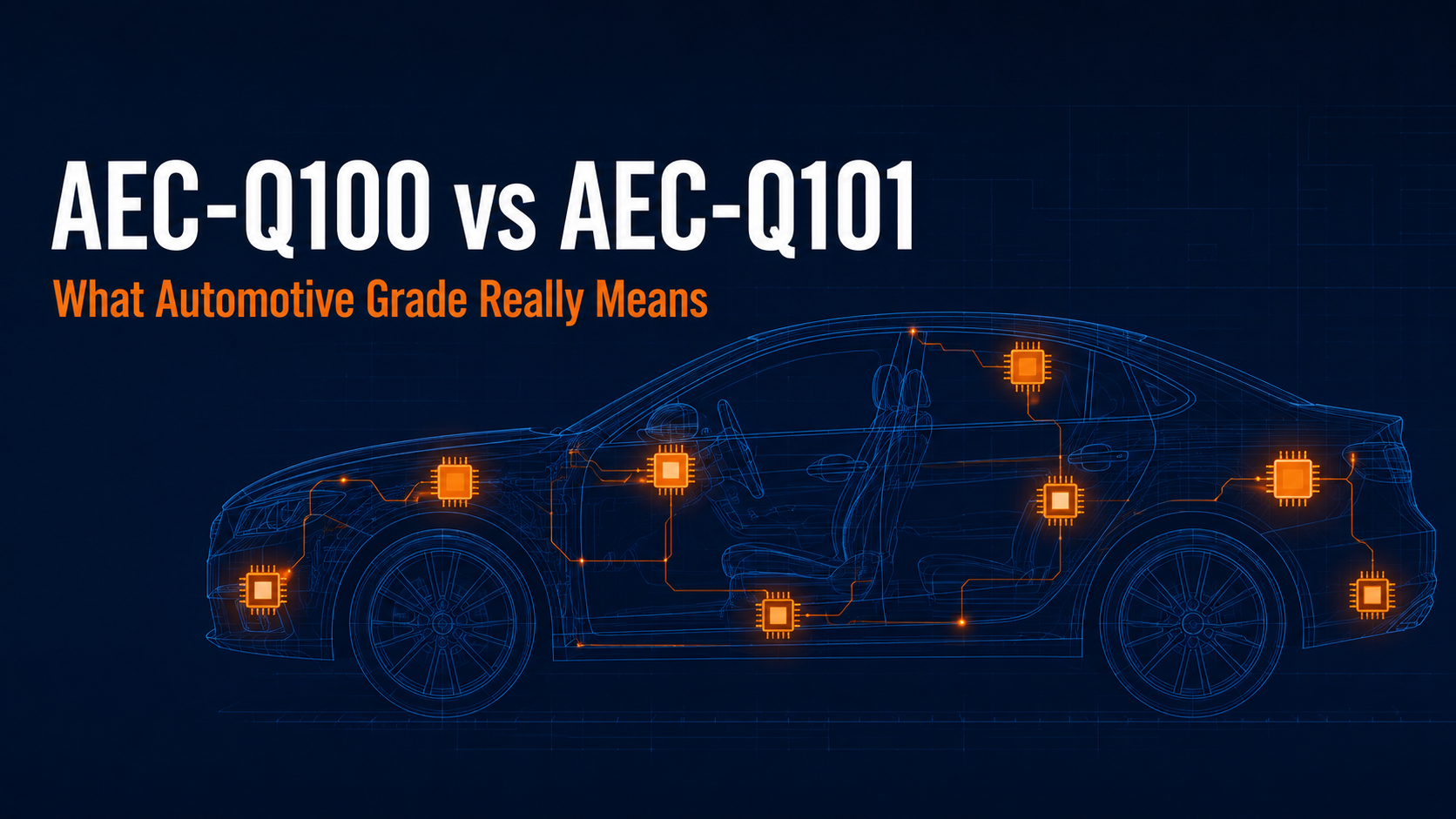
AEC-Q100 and AEC-Q101 are the two qualification standards that decide whether a semiconductor may be called automotive grade. The split is simple: AEC-Q100 covers packaged integrated circuits such as microcontrollers, memory and logic, while AEC-Q101 covers discrete semiconductors such as MOSFETs, diodes and transistors. Both were defined by the Automotive Electronics Council (AEC), the body founded in the 1990s by Chrysler, Ford and General Motors together with their component suppliers to standardise the stress testing a part must survive before it goes into a vehicle. If you buy components for automotive or other high-reliability builds, the suffix on the ordering code and the Q-number behind it determine what you can put on your BOM, so this guide explains both standards and shows qualified parts you can source immediately.
The AEC-Q family at a glance
Each AEC standard targets one component class, because a DRAM fails differently from a power MOSFET and both fail differently from a ceramic capacitor. The main documents:
| Standard | Covers | Typical parts |
|---|---|---|
| AEC-Q100 | Packaged integrated circuits | MCUs, DRAM, flash, logic, analog ICs |
| AEC-Q101 | Discrete semiconductors | MOSFETs, BJTs, diodes, TVS, thyristors |
| AEC-Q102 | Optoelectronics | LEDs, photodiodes, laser diodes |
| AEC-Q104 | Multichip modules | SiP, power modules |
| AEC-Q200 | Passive components | Resistors, capacitors, inductors |
What AEC-Q100 requires from an IC
AEC-Q100 is a failure-mechanism-based qualification: the part must survive a defined battery of stresses that reproduce how ICs actually die in the field, including high-temperature operating life, temperature cycling, humidity bias, ESD (both human body and charged device model) and latch-up testing. The standard also defines temperature grades, from Grade 3 (-40 to +85 degrees C ambient) up to Grade 0 (-40 to +150 degrees C), so a buyer can match the part to the placement: a dashboard cluster lives an easier life than an engine-bay module. When a memory vendor like Micron marks an ordering code with an automotive temperature grade, that code, not the family name, carries the qualification.
What AEC-Q101 requires from a discrete
AEC-Q101 applies the same philosophy to discretes, with stresses that matter for power parts: unclamped inductive switching (UIS), gate charge integrity, temperature cycling and ESD. Manufacturers often go beyond the minimum; Vishay and Nexperia, for example, ship AEC-Q101 MOSFETs that are 100 percent Rg and UIS tested in production, not just qualified on a sample. A discrete that carries AEC-Q101 in its datasheet has earned the automotive label; a commercial twin from the same family has not, even when the electrical specs look identical.
What qualification means when you are buying, not designing
Three practical rules follow from how the AEC system works. First, there is no central certificate: the AEC publishes the test documents, and each manufacturer qualifies its own parts against them, backed by qualification data and PPAP documentation on request. Second, the qualification is tied to the exact ordering code, including temperature grade and sometimes the assembly site, which is why an alternate suffix is not automatically a second source, a trap we cover in our guide to second sourcing electronic components. Third, and most important on the open market: an automotive-grade part without traceability is not an automotive-grade part. The qualification lives in the supply chain as much as in the silicon, so provenance documentation, incoming inspection and anti-counterfeit checks are what preserve the value you are paying for, the same discipline that applies to RoHS compliance claims.
AEC-qualified parts in stock at GlobX now
These are automotive-qualified components currently on our shelves, each verified against the manufacturer's own documentation, each with full traceability and a certificate of conformance on request:
AEC-Q100 (ICs and memory): the Micron MT41K64M16TW-107 AAT:J, a 1Gb DDR3L SDRAM rated -40 to +105 degrees C for infotainment, clusters and telematics, a generation that Samsung and SK hynix have already exited; and the Micron MT29F1G08ABAFAH4-AAT:F, a 1Gb SLC NAND boot flash in the same automotive grade, the storage class ECUs rely on for deterministic boot.
AEC-Q101 (discretes): the Nexperia BUK9Y25-80E,115, an 80 V, 27 mOhm logic-level TrenchMOS in LFPAK56 that we hold in six figures while Nexperia franchised supply remains constrained (see our Nexperia alternatives guide); the Vishay SQ4532AEY-T1_GE3, a complementary N plus P channel 30 V MOSFET pair whose last time buy date is 23 August 2026, after which franchised stock will not be replenished; and the onsemi SMUN5312DW1T1G, a dual pre-biased transistor for digital switching in body electronics.
How GlobX helps
GlobX is an independent electronic-component distributor in Neu-Isenburg, Germany, supplying OEM and EMS teams across Europe. Every automotive-grade shipment passes ISO 9001 incoming inspection with anti-counterfeit checks and ships with full traceability, so the qualification you specify is the qualification you receive. Whether you need one of the parts above, a hard-to-find AEC-qualified device, or last-time-buy coverage before a window closes, request a quote with part number, quantity and date-code requirements, and we respond within 24 hours.
Deutsche Version: AEC-Q100 vs. AEC-Q101 - Automotive-Qualifizierung erklärt.