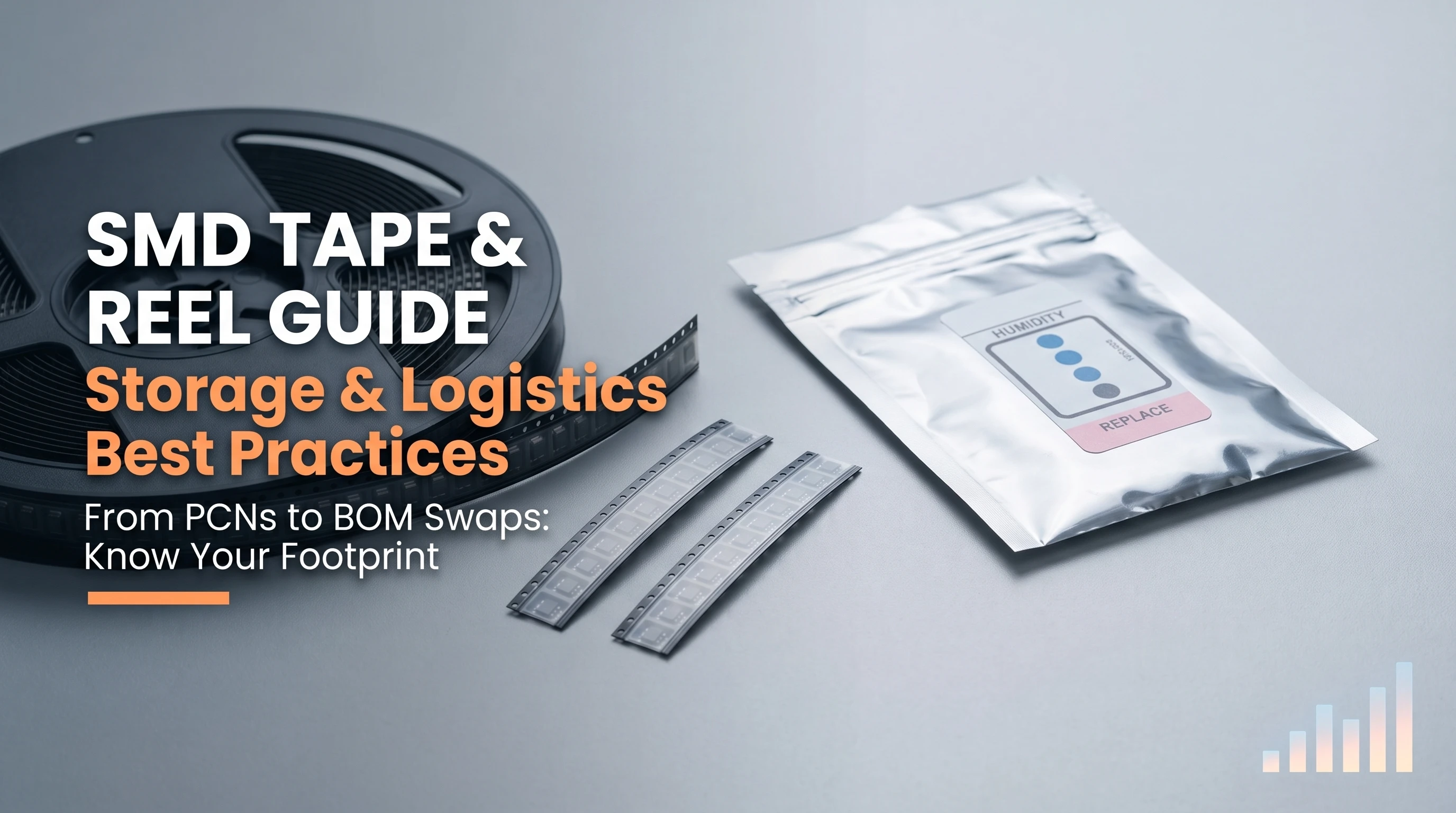
On most surface-mount parts the packaging format is not a shipping preference you choose at checkout. It is welded into the orderable part number. LT8640IUDC-1#PBF and LT8640IUDC-1#TRPBF are the same Analog Devices Silent Switcher die in the same 12-lead DFN package; the letters TR are the only reason one arrives on a reel and the other does not. Buyers who treat the suffix as cosmetic end up with 14,890 pieces their pick-and-place machine cannot feed, and a restocking conversation nobody enjoys.
This guide compares the six formats you will actually be offered, shows how to decode the suffix before you raise the purchase order, and covers the part most packaging articles skip: what happens to the moisture-barrier seal when a reel is cut.
The six packaging formats, and what each one costs you
There are six formats in routine circulation for SMD parts, and the choice is driven almost entirely by order quantity and whether a machine or a human will place the part. Full reel wins above roughly 1,000 pieces, cut tape wins below about 100, and everything in between is a judgement call about feeder setup time.
| Format | Typical quantity | What arrives | Best for | What you give up |
|---|---|---|---|---|
| Full reel | 1,000 to 50,000 | Sealed reel, 7 in (178 mm) or 13 in (330 mm) | Automated SMT production runs | Cash tied up in one MOQ step |
| Partial reel | 500 and up | Remaining parts still on the original reel hub | Mid-volume builds and top-ups | Often a price premium per piece |
| Cut tape | 1 to a few hundred | Loose strips in an ESD or moisture-barrier bag | Prototypes, rework, line-down repairs | Machine feeding, and often the original seal |
| Tube (stick magazine) | 25 to 100 per tube | Rigid anti-static tubes | SOIC, TSSOP, through-hole DIP | Throughput, because tube feeders run slower |
| Tray (JEDEC matrix) | 24 to 500 per tray | Stacked matrix trays, usually baked and sealed | BGA, QFN, large fine-pitch packages | Bench space and a tray feeder |
| Bulk or ammo pack | Varies widely | Loose parts, or tape fan-folded into a box | Leaded passives, hand assembly | Orientation control and traceability |
Ammo pack deserves a note because it confuses people: it is the same carrier tape as a reel, simply fan-folded into a carton instead of wound on a hub. Feeders take it happily, it ships cheaper than a reel, and it is common on leaded passives from European and Japanese makers.
The suffix is the format, not a shipping option
Packaging codes live at the end of the part number, and ordering the wrong one gets you the wrong box. The pattern is consistent enough to read at a glance: TR or T&R means tape and reel, RL or -REEL means reel, a trailing -T usually means taped, and CT is a distributor-side label for cut tape rather than a manufacturer code.
Analog Devices makes this unusually legible. #PBF is lead-free in bulk or tube, and #TRPBF is lead-free on tape and reel. Same silicon, same datasheet, two separate line items with separate stock pools. Texas Instruments uses a trailing R for a reeled version and no suffix for tube, so SN75176BDR is reel and SN75176BD is not. Allegro appends TR-T, and you will see codes such as -RL7 for a 7 inch reel on ADI converters.
One code is not a manufacturer format at all. Digi-Reel is a catalogue distributor service that winds a custom quantity onto a proprietary reel with a machine-readable leader, so it feeds like a reel but is billed as a made-to-order cut. If a quote lists Digi-Reel, you are buying a repackaging service on top of the part, and the original manufacturer reel is not what turns up.
What the taping standard guarantees, and what it does not
Carrier tape is standardised dimensionally, not commercially. The international standard is IEC 60286-3:2022, Packaging of components for automatic handling, Part 3: packaging of surface mount components on continuous tapes, now in edition 7.0. In North America the same ground is held by EIA-481, maintained through the ECIA standards programme, which formulates EIA standards and runs the US technical advisory groups that feed into IEC committees. The two are aligned in practice, which is why 8 mm tape from a Japanese passive maker feeds correctly in a German feeder.
What the standard fixes: tape width (8, 12, 16, 24 mm and up), pocket pitch, sprocket hole spacing, cover-tape peel force, component orientation inside the pocket, and the requirement for empty leader and trailer tape so the strip can be threaded into a feeder. What it does not fix is how many pieces go on a reel. Piece count is a manufacturer decision tied to package size, which is why one 13 inch reel holds 2,500 SOIC parts and another holds 10,000 chip resistors. Never infer quantity from reel diameter on a quote.
Cut tape breaks the moisture-barrier chain
Any part rated MSL 2 or higher leaves the factory inside a sealed moisture-barrier bag with desiccant and a humidity indicator card, and the clock on its floor life starts only when that bag is opened. Cutting a reel opens the bag. The distributor reseals it, but the reseal is their seal rather than the manufacturer seal, and the floor-life budget you inherit is whatever was left over.
In practice this means three things for a buyer. Ask for the bag seal date, not just the date code. Ask whether the parts were rebaked before resealing. And if the part is a fine-pitch BGA going through two reflow passes, prefer a full reel or a factory-sealed tray and keep the original bag intact. Our guide to moisture sensitivity levels and floor life sets out the exposure budgets by MSL class, and component shelf life and date codes covers what ages in storage and what does not.
The practitioner gotcha: a resealed cut-tape bag with a fresh humidity indicator card looks exactly like a factory bag in a goods-in photo. The difference shows up in the seal width and the paperwork, so it belongs in your incoming inspection checklist rather than in a visual spot check.
Sourcing in allocation, when the format picks you
As of September 2026 the market is in selective allocation rather than broad shortage, with memory, high-capacitance MLCCs, SiC and GaN power devices and several legacy discrete families quoted well past 26 weeks. In that climate the packaging format stops being a preference. Stock exists in whatever form the previous owner held it, and a buyer chasing a line-down part takes cut tape from excess inventory because the alternative is a 40 week factory lead time.
Two risks rise when you buy outside the format you wanted. Re-reeled parts, meaning loose or cut stock wound onto a fresh reel by a third party, lose the direct link to factory packaging that normally supports traceability, which is one reason re-reeling shows up so often in counterfeit case studies. Read our guide to avoiding counterfeit electronic components before accepting re-reeled stock on a safety-relevant board. Second, mixed date codes inside one bag are normal for aggregated cut tape and abnormal for a factory reel, so decide up front which one your process accepts. Our overview of how component allocation works explains why the good formats disappear first, and franchised versus independent distribution covers which channel holds which kind of stock.
A worked example: 6,900 on reel against 14,890 in bulk
Take a real pair from the GlobX catalogue, verified as of 11 September 2026. LT8640IUDC-1#TRPBF is Active with 6,900 units in stock, on tape and reel. LT8640IUDC-1#PBF is the same Active device with 14,890 units in stock, without the TR code. A buyer who searches only the base number LT8640IUDC-1 sees 21,790 pieces and assumes plenty of reel stock. There are 6,900.
The same split runs through the catalogue. AD8403ARZ50-REEL shows 4,800 units while AD8403ARZ50 shows 5,000 of the same digital potentiometer in tube. If your build needs 8,000 on reel, neither line covers it alone, and the honest answer is a partial reel plus a cut-tape balance, or a split delivery. That is a very different conversation from the one that starts with a single aggregate stock figure.
The lesson generalises: search and quote at the full orderable part number including the packaging suffix, and treat the base number as a family rather than a stock position.
What to write on the purchase order
A packaging dispute is nearly always a purchase order that stayed silent on five lines. Specify them and the argument disappears.
- Full orderable part number including the packaging suffix, written out rather than implied.
- Format in words as well as code, for example "tape and reel, 13 inch, factory sealed", so a mismatch is caught at order entry.
- Acceptable date code window, and whether mixed date codes are permitted in one delivery.
- MSL bag condition: factory sealed or resealed, seal date required, desiccant and humidity indicator card present.
- Documentation: a certificate of conformance naming the packaging format as delivered.
Those five lines cost nothing at order entry and settle almost every goods-in packaging question before it starts.
Need a specific packaging code rather than whatever the aggregate stock figure suggests? Send us the full part number with its suffix and the quantity you need on reel, and we will tell you what is genuinely available in that format, in writing, within 24 hours.