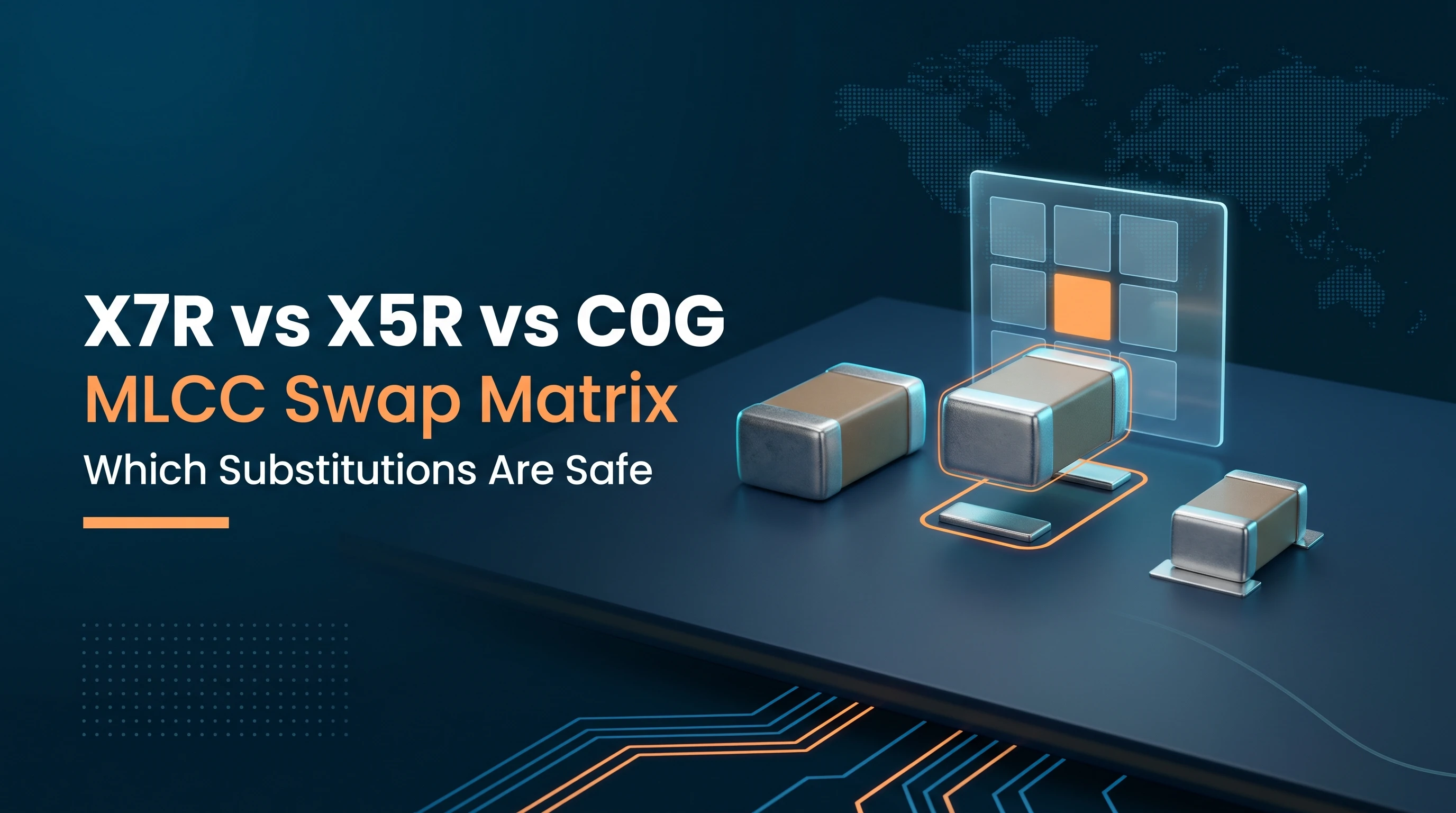
X7R, X5R and C0G are the three MLCC dielectrics on most European BOMs, and they are not interchangeable in both directions. C0G (Class 1) holds its capacitance within ±30 ppm/°C from -55 to +125 °C and does not lose capacitance under DC voltage. X7R and X5R (Class 2) allow ±15% drift with temperature, lose capacitance as DC voltage rises and age over time. X7R is rated to +125 °C and X5R only to +85 °C. A buyer can approve some swaps between them alone. Others need an engineer's signature. This guide gives the code chart, a 9-row swap matrix and three worked examples from GlobX stock.
X7R vs X5R vs C0G at a glance
C0G is the precise dielectric, X7R is the general-purpose workhorse, and X5R is the high-capacitance, lower-temperature option. Murata describes the split in its dielectric comparison FAQ: the temperature-compensating type (C0G) uses calcium zirconate and has neither DC bias nor aging effects, while the high-dielectric types (X5R, X7R) use barium titanate and have both.
| Property | C0G (NP0) | X7R | X5R |
|---|---|---|---|
| EIA class | Class 1 | Class 2 | Class 2 |
| Temperature range | -55 to +125 °C | -55 to +125 °C | -55 to +85 °C |
| Capacitance change over range | 0 ±30 ppm/°C (about ±0.3%) | ±15% | ±15% |
| Loss under DC bias | None | Yes, size and voltage dependent | Yes, often severe in small cases |
| Aging | None | Yes | Yes |
| Capacitance per case size | Lowest | Medium | Highest |
| Typical circuit roles | Timing, oscillators, filters, RF matching, ADC sampling | Decoupling, bypass, EMI filtering, automotive general use | Bulk decoupling and LDO output in consumer and low-temperature boards |
The bottom row is the one buyers forget. The circuit role, not the capacitance value, decides which dielectric is acceptable. A 100 nF part on the BOM tells you nothing until you know whether it sits on a 3.3 V rail or sets an RC filter corner.
How to read a dielectric code in three characters
A Class 2 code such as X7R is three characters: the low temperature limit, the high temperature limit and the maximum capacitance change across that range. The table below decodes the characters that appear on real MLCC datasheets.
| Character | Position | Meaning |
|---|---|---|
| X / Y / Z | 1st (low limit) | -55 °C / -30 °C / +10 °C |
| 4 / 5 / 6 / 7 / 8 / 9 | 2nd (high limit) | +65 / +85 / +105 / +125 / +150 / +200 °C |
| P / R / S | 3rd (change) | ±10% / ±15% / ±22% |
| T / U / V | 3rd (change) | +22/-33% / +22/-56% / +22/-82% |
So X5R reads "-55 to +85 °C, ±15%", X7S reads "-55 to +125 °C, ±22%" and Y5V reads "-30 to +85 °C, +22/-82%". C0G is a Class 1 code with a different logic: the C and 0 give a temperature coefficient of 0 ppm/°C, and the G sets the tolerance on that coefficient at ±30 ppm/°C. The dielectric code is separate from the capacitance tolerance letter (J, K, M) in the ordering code. Our part number suffix decoder covers the other fields of a full ordering code.
The swap matrix: which dielectric substitutions a buyer can approve
Two dielectric swaps are safe for purchasing to approve alone. Five need an engineer to check a curve or a temperature. Two should be refused outright. In every row, the voltage rating, case size and thickness must also match or improve.
| Original | Proposed | Verdict | Condition |
|---|---|---|---|
| C0G | C0G from another maker | Buyer can approve | Same value, tolerance, voltage, case. Some makers print it NP0. |
| X7R | C0G | Buyer can approve if it exists | Electrically better, but the same value often needs a larger case. Check the footprint. |
| X7R | X8R | Engineer checks the curve | Wider range (+150 °C), same ±15%, but the DC bias curve differs by maker. Usually costs more. |
| X5R | X7R | Engineer checks the curve | Temperature is better, but effective capacitance at the rail voltage can be lower. |
| X5R | X6S | Engineer checks | +105 °C is better, ±22% is wider than ±15%. |
| X7R | X7S | Engineer checks | Same range, ±22% instead of ±15%. |
| X7R | X5R | Engineer signs off | Only if worst-case part temperature stays below +85 °C, including self-heating. |
| C0G | X7R or X5R | Refuse | Timing, filter, RF and sampling circuits drift or detune. |
| X7R or X5R | Y5V or Z5U | Refuse | Up to -82% change. Not an acceptable substitute in decoupling or filter roles. |
The matrix covers the dielectric only. The full substitution check, including AEC-Q200 grade and flexible terminations, is the 6-point list in our MLCC shortage 2026 guide. Every approved alternate should then be recorded as a formal second source, as described in the second-sourcing guide.
The DC bias trap: X7R is not always better than X5R
The dielectric letter tells you how capacitance moves with temperature, not how much it loses under voltage. That loss depends mostly on the case size, the rated voltage and the maker's ceramic formulation. Murata states in its DC bias FAQ that high-dielectric types such as X5R, X6S and X7R lose capacitance as the applied DC voltage rises, while C0G has no DC bias characteristic.
A complaint buyers hear from engineers, and one that recurs on German forums such as mikrocontroller.net, is that a 10 µF ceramic measures far below 10 µF once it sits on the powered board. The part is not faulty. A small, high-value Class 2 MLCC can deliver less than half its label value at its working voltage. Two consequences matter for sourcing:
- An X7R alternate can give less effective capacitance than the X5R it replaces in the same case and voltage rating, because the X7R formulation trades capacitance density for temperature stability. Compare both parts on the makers' DC bias curves at the real rail voltage, never at 0 V.
- A higher voltage rating in the same case usually helps. Moving from a 6.3 V to a 16 V part on a 5 V rail is often the easiest way to recover lost capacitance, provided the thickness still fits.
The practical rule: when an alternate changes the dielectric, the voltage rating or the case size, ask for its capacitance at your working voltage, not its label value.
Worked example: three dielectric codes from GlobX stock
Each maker writes the dielectric differently in its ordering code, and one hides it completely. These three parts were in stock at GlobX as of October 2026.
- TDK C4532C0G2E473J320KA (10,000 pcs, date code 19+). TDK prints the dielectric in plain text: 4532 is the metric case (1812 imperial), C0G the dielectric, 2E means 250 V, 473 means 47 nF, J is ±5% and 320 is the 3.2 mm thickness. The lesson is density: 47 nF in C0G at 250 V needs an 1812 case, while a 47 nF X7R at a low voltage fits in 0402. If a C0G part is short, the real alternative is another C0G, not a smaller X7R. Check the date code against our shelf life and date code guide before accepting older lots.
- YAGEO CC0402JRNPO9BN330 (189,000 pcs, date code 22+). YAGEO writes the same Class 1 dielectric as "NPO", with the letter O. Here 0402 is the case, J is ±5%, R is the reel packaging code, 9 means 50 V and 330 means 33 pF. A BOM search for the string "C0G" will never find this part.
- KYOCERA AVX FS031C103K4Z2A (130,000 pcs, date code 23+). Neither this legacy code nor its new global part number, KAS15AR72A103KT, contains the string X7R. Only the datasheet or our listing tells you it is a 100 V, 10 nF, X7R, 0603 part with flexible terminations and AEC-Q200 qualification.
The gotcha: a dielectric search across a BOM or an ERP export needs four strings (C0G and NP0 with a zero, COG and NPO with the letter O), plus a datasheet lookup for makers whose codes hide the dielectric. Our cross-reference guide explains how to build the comparison once the dielectric is known.
What to put on an RFQ when the dielectric might change
An RFQ that allows a dielectric change should state seven facts, so the supplier can offer a valid alternate on the first reply instead of a guess:
- The circuit role: decoupling, bulk, filter, timing or RF.
- The DC voltage across the part in operation.
- The maximum component temperature, not the ambient.
- The minimum effective capacitance needed at that voltage.
- The case size and the maximum height that fits.
- Whether AEC-Q200 or flexible terminations are required.
- The dielectrics engineering has already approved, for example "X7R or X8R, no X5R".
Send that list with the part numbers to GlobX and we will match the dielectric, voltage and case against stock held in Europe, and flag any alternate that needs an engineer's sign-off before it ships.