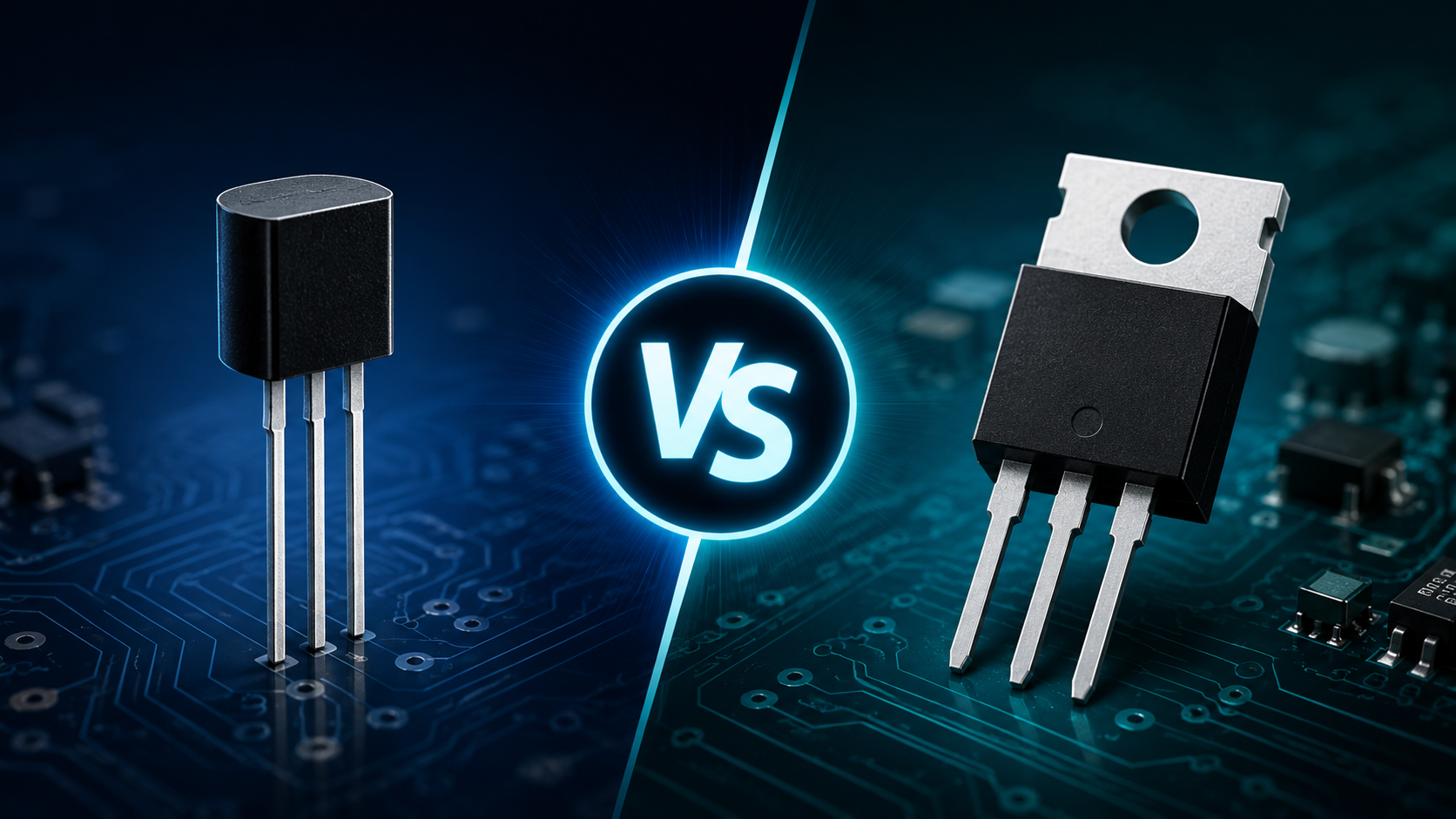
BJT vs MOSFET comes down to how each transistor is controlled and where it loses energy. A BJT (bipolar junction transistor) is current-driven and cheap with high gain, while a MOSFET (metal-oxide-semiconductor field-effect transistor) is voltage-driven, switches faster, and wastes less power in most switching jobs. As a rule of thumb, choose a MOSFET for efficient power switching and high frequency, and choose a BJT for low-cost signal switching, simple amplification, or very low-current analog stages. This guide explains how each device works, the key differences, when to use which, and how to source the right part in Europe.
Both are three-terminal semiconductor switches, so they look interchangeable on a schematic, but their internal physics makes them behave very differently under load. Picking the wrong one costs efficiency, heat, and board space, so the decision is worth getting right early in a design.
What Is a BJT?
A BJT is a current-controlled transistor with three terminals: base, collector, and emitter. A small base current controls a much larger collector current, set by the current gain (hFE or beta). Because conduction uses both electrons and holes (bipolar), a BJT has a roughly fixed collector-emitter saturation voltage of a few tenths of a volt when fully on. BJTs are inexpensive, offer high gain, and remain popular in analog amplifiers, low-power signal switching, and references.
What Is a MOSFET?
A MOSFET is a voltage-controlled transistor with a gate, drain, and source. A voltage on the insulated gate creates a channel that lets current flow from drain to source, so the gate draws almost no steady current. Its on-state behaves like a low resistance (RDS(on)), so conduction loss rises with the square of current. MOSFETs switch quickly with low drive power, which makes them the default choice for switch-mode power supplies, DC-DC converters, and motor drives.
BJT vs MOSFET: The Key Differences
The core differences follow directly from current-driven (BJT) versus voltage-driven (MOSFET) operation:
| Attribute | BJT | MOSFET |
|---|---|---|
| Control | Current-driven (base current) | Voltage-driven (gate voltage) |
| Drive power | Continuous base current needed | Almost zero steady gate current |
| On-state | Fixed saturation voltage (VCE(sat)) | Resistive (RDS(on)) |
| Switching speed | Slower (carrier storage time) | Faster (no storage time) |
| Input impedance | Low | Very high |
| Thermal behavior | Prone to thermal runaway | Stable, easy to parallel |
| Typical use | Amplifiers, low-power signal switching | SMPS, DC-DC, motor and power switching |
When to Use a BJT
Choose a BJT when cost and simple gain matter more than switching efficiency:
- Small-signal switching of LEDs, relays, and logic-level loads where current is low.
- Linear amplification in audio, sensor front-ends, and discrete analog stages.
- Low-cost, low-voltage designs where a few tenths of a volt of saturation loss is acceptable.
When to Use a MOSFET
Choose a MOSFET when efficiency, speed, or high current are priorities:
- Power switching in SMPS, DC-DC converters, and battery management where low RDS(on) cuts heat.
- High-frequency loads (Class-D audio, synchronous rectification) that need fast, low-loss switching.
- Motor control and load switches where the gate can be driven directly from a controller or driver.
How to Choose Between a BJT and a MOSFET
Work through four questions in order:
- Is it switching or amplifying? For efficient on/off power switching, lean MOSFET. For linear gain, a BJT is often simpler.
- How much current? Above roughly an amp, a MOSFET's resistive loss usually beats a BJT's fixed saturation drop and base-current overhead.
- What switching frequency? Above tens of kHz, MOSFET speed and low drive power win; below that, a BJT can be fine.
- What is the drive available? A microcontroller pin can drive a logic-level MOSFET gate directly, while a BJT needs a base resistor and continuous current.
Where IGBT and SiC Fit
At high voltage and high current the comparison extends beyond these two devices. The IGBT combines a MOSFET-style gate with a bipolar output for high-power, lower-frequency stages, while silicon-carbide (SiC) MOSFETs deliver high voltage with fast switching. If your design sits at mains voltage or above, read our companion guide on MOSFET vs IGBT, and see a worked power-MOSFET example in the Infineon IPA60R360P7 CoolMOS post. For a wider map of part families, see our guide to the types of electronic components.
How GlobX Helps You Source BJTs and MOSFETs
GlobX is an independent distributor and supply-chain specialist that sources transistors and power semiconductors from a verified global network and the open market, with ISO 9001 processes, anti-counterfeit inspection, full traceability, and 24-hour quotes. Whether you have settled on a device or need a second source during allocation, browse live MOSFETs in our catalog, search all component availability, or see how our electronic component sourcing works. Chasing an obsolete or allocated transistor? Send your part list to the GlobX team for a 24-hour quote.
Frequently Asked Questions
What is the main difference between a BJT and a MOSFET? A BJT is current-driven through its base and conducts using both electrons and holes, while a MOSFET is voltage-driven through an insulated gate and conducts with one carrier type. MOSFETs switch faster and need almost no steady drive current; BJTs offer high gain at low cost.
Is a BJT faster than a MOSFET? No. MOSFETs switch faster than BJTs because they have no minority-carrier storage time and are driven by gate voltage rather than base current. This makes MOSFETs better for high-frequency switching such as SMPS and Class-D, while BJTs suit lower-frequency analog and amplifier stages.
Can I use a BJT instead of a MOSFET? Sometimes, but not as a drop-in. A BJT needs continuous base current and has a fixed saturation voltage, so it dissipates more power when switching heavy loads. For low-current signal switching or linear amplification a BJT works well; for efficient power switching a MOSFET is usually the better choice.
Why are MOSFETs preferred over BJTs for switching? MOSFETs are preferred for switching because they are voltage-controlled, draw almost no gate current, switch quickly, and have a low on-resistance (RDS(on)) that keeps conduction loss down. They are also easier to parallel and less prone to thermal runaway, which makes them efficient in power converters.
Two stocked examples make the comparison tangible: on the bipolar side, the onsemi SMUN5312DW1T1G packs a pre-biased NPN and PNP pair (a bias resistor transistor) into one SOT-363 for digital switching, while on the MOSFET side the Nexperia BSS138BK is the classic small-signal N-channel used for logic-level switching and level shifting. Both are available at GlobX with full traceability.