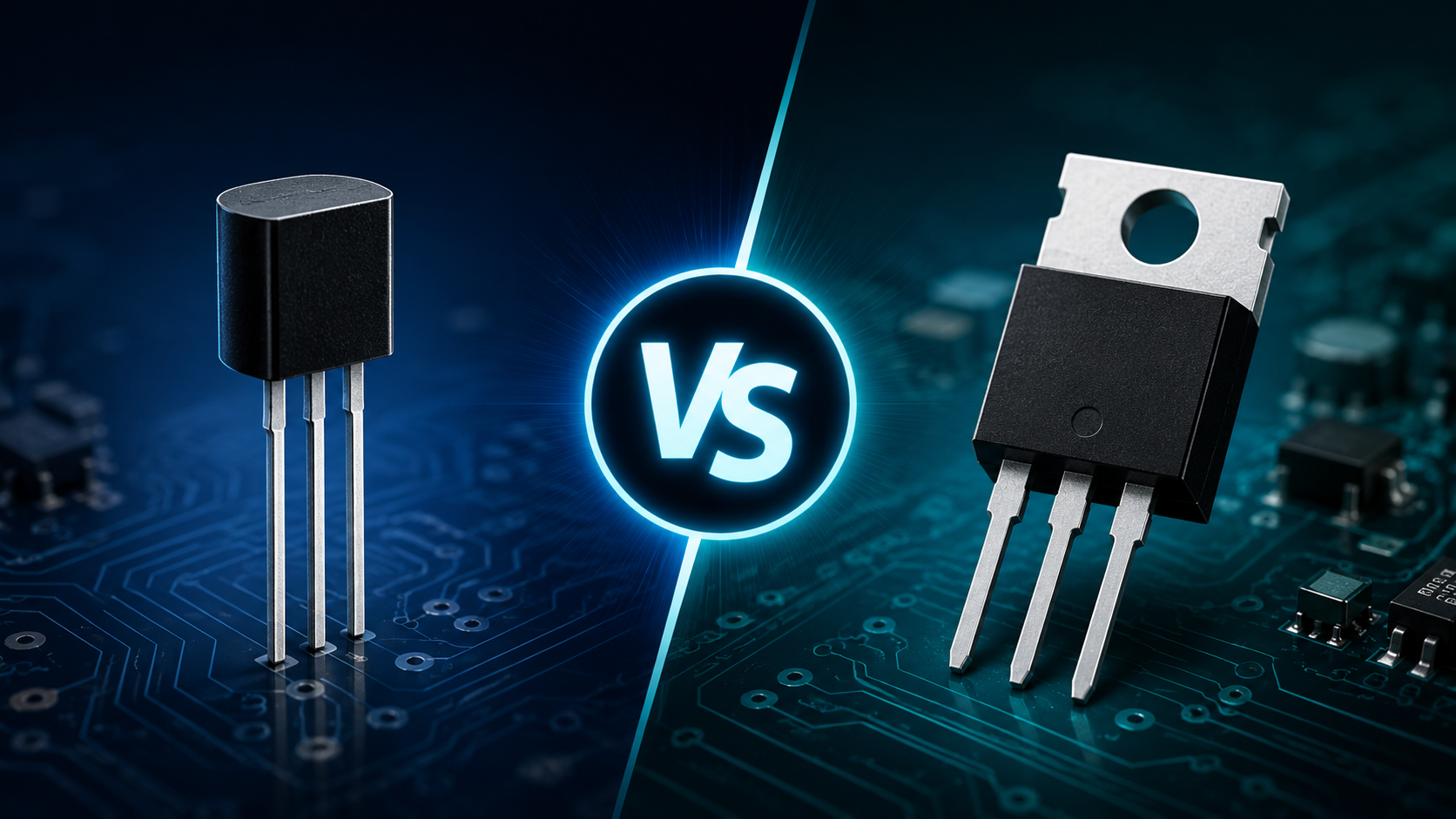
MOSFET vs IGBT comes down to a simple trade-off: a MOSFET wins at high switching frequency and low-to-medium voltage, while an IGBT wins at high voltage and high current. As a rule of thumb, choose a MOSFET above roughly 100 kHz and below a few hundred volts, and choose an IGBT for high-power, high-voltage stages switching below about 20 kHz. This guide explains how each device works, the key differences, when to use which, and how to source the right part.
Both are voltage-controlled power switches, so they look similar on a schematic, but their internal structure makes them behave very differently under load. Picking the wrong one costs efficiency, heat, and reliability, so the decision is worth getting right early in a design.
What Is a MOSFET?
A MOSFET (metal-oxide-semiconductor field-effect transistor) is a majority-carrier device that switches very fast with low conduction loss at low-to-medium voltages. Its on-state behaves like a resistor (RDS(on)), so conduction loss rises with the square of current. MOSFETs dominate switching power supplies, DC-DC converters, and any circuit that needs high-frequency switching.
What Is an IGBT?
An IGBT (insulated-gate bipolar transistor) combines a MOSFET-style gate with a bipolar output stage. That bipolar output gives a roughly fixed forward voltage drop instead of a resistance, so conduction loss scales more slowly at high current. IGBTs are built for high-voltage, high-current power conversion such as motor drives, inverters, and EV traction.
MOSFET vs IGBT: The Key Differences
The core differences follow directly from majority-carrier (MOSFET) versus bipolar (IGBT) conduction:
| Attribute | MOSFET | IGBT |
|---|---|---|
| Best voltage range | Low to medium (up to a few hundred V) | High (hundreds to thousands of V) |
| Best switching frequency | High (often above 100 kHz) | Low to medium (typically below 20 kHz) |
| Conduction loss | Resistive, rises with current squared | Fixed voltage drop, better at high current |
| Switching loss | Low (fast) | Higher (tail current) |
| Gate drive | Often direct from a driver or even an MCU pin | Needs a dedicated gate driver, often plus/minus rail |
| Typical use | SMPS, DC-DC, low-power motor control | Inverters, EV drives, welding, large motor drives |
When to Use a MOSFET
Choose a MOSFET when switching speed matters and the voltage is moderate:
- Switch-mode power supplies and DC-DC converters running at high frequency for small magnetics.
- Low-to-medium voltage motor control and battery-powered systems where efficiency at light load counts.
- Fast-switching loads (Class-D audio, RF, synchronous rectification) up to MHz ranges.
When to Use an IGBT
Choose an IGBT when voltage and current are high and the frequency is moderate:
- Motor drives and industrial inverters at mains voltage and above.
- EV traction inverters and on-board power stages handling hundreds of amperes.
- Welding, induction heating, and UPS systems where rugged high-current handling beats raw speed.
How to Choose Between MOSFET and IGBT
Work through three questions in order:
- What is the bus voltage? Below a few hundred volts, a MOSFET is usually the better start. Above that, an IGBT is often the only practical choice.
- What switching frequency do you need? Above roughly 20 to 50 kHz, MOSFET switching losses stay low while IGBT tail-current losses grow. Below that, an IGBT is efficient and rugged.
- How much current at steady state? At high continuous current the IGBT's fixed voltage drop beats the MOSFET's squared resistive loss.
For background on how these parts fit the wider catalog, see our guide to the types of electronic components, and a worked power-MOSFET example in the Infineon IPA60R360P7 CoolMOS post.
Where SiC Changes the Line
The traditional boundary is shifting. Silicon-carbide (SiC) MOSFETs now handle high voltages (650 V to 1200 V and beyond) with fast switching and low losses, so they increasingly compete with IGBTs in EV and solar inverters where designers want both high voltage and high frequency. When you evaluate MOSFET vs IGBT today, add SiC MOSFET as a third option for high-voltage, high-efficiency designs, and weigh its higher unit cost against smaller magnetics and better efficiency.
How GlobX Helps You Source MOSFETs and IGBTs
GlobX is an independent distributor and supply-chain specialist that sources power semiconductors from a verified global network and the open market, with ISO 9001 processes, anti-counterfeit inspection, full traceability, and 24-hour quotes. Whether you have settled on a part or need a second source, browse live MOSFETs and IGBTs in our catalog, search all component availability, or see how our electronic component sourcing works. Stuck on allocation or chasing an obsolete power switch? Send your part list to the GlobX team for a 24-hour quote.
Choosing between a bipolar and a field-effect device first? See our companion guide on BJT vs MOSFET before stepping up to an IGBT for high-power stages.
Frequently Asked Questions
What is the main difference between a MOSFET and an IGBT? A MOSFET is a majority-carrier device that switches fast with resistive conduction loss, best for low-to-medium voltage and high frequency. An IGBT has a bipolar output with a fixed voltage drop, best for high voltage and high current at lower switching frequencies.
When should I use an IGBT instead of a MOSFET? Use an IGBT when the bus voltage is high (hundreds of volts or more) and the current is large, such as motor drives, industrial inverters, EV traction, and welding, where switching frequency stays below about 20 kHz.
Is a MOSFET faster than an IGBT? Yes. MOSFETs switch faster and have lower switching losses, so they suit high-frequency applications above roughly 100 kHz. IGBTs have tail-current switching losses that make them less efficient at high frequency.
Are SiC MOSFETs replacing IGBTs? In some high-voltage, high-efficiency designs, yes. Silicon-carbide MOSFETs deliver high voltage with fast switching, so they increasingly compete with IGBTs in EV and solar inverters, though at a higher unit cost.
Example, on the MOSFET side of the line: a low-voltage high-side switch such as Vishay's SI7113ADN-T1-GE3, a P-channel 100 V TrenchFET in a PowerPAK 1212-8, is exactly the kind of load-switch and DC/DC job where a MOSFET is the right tool and an IGBT would be the wrong one. IGBTs earn their place at much higher voltages and currents, where their conduction loss stops scaling with die area the way a MOSFET's on-resistance does.