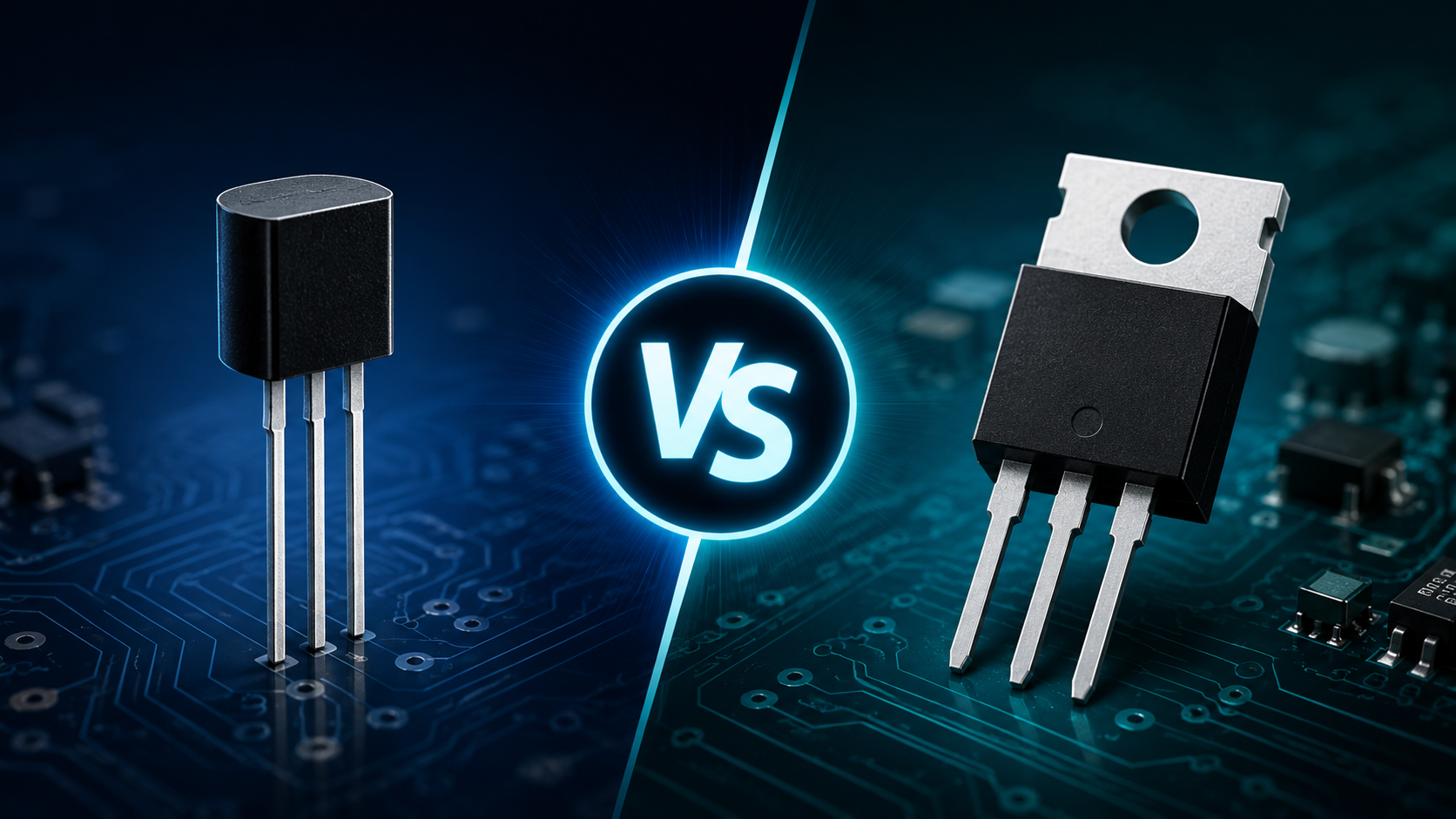
Electronic components are the individual parts that build every circuit, from a simple LED torch to an industrial control board. They fall into two big families: passive components that store or limit energy (resistors, capacitors, inductors) and active components that control or amplify current (diodes, transistors, integrated circuits). This guide explains the main types of electronic components, what each one does, and how to choose and source the right part.
Whether you are a student learning the basics, an engineer reviewing a design, or a buyer sourcing a Bill of Materials, knowing how components are grouped makes selection, troubleshooting, and procurement far easier. Below we break down each category with its function and typical uses.
What Are Electronic Components?
An electronic component is a discrete device that performs a defined electrical function within a circuit. Components are mounted on a printed circuit board (PCB) and connected to form a working system. They are broadly classified as passive, active, or electromechanical, and many are sold as either through-hole or surface-mount (SMD) packages.
Active vs Passive Components
The first distinction every engineer learns is active versus passive. The difference is whether a part needs external power to do its job.
| Type | Needs power source? | Function | Examples |
|---|---|---|---|
| Passive | No | Store, dissipate, or filter energy; cannot add power to a signal | Resistors, capacitors, inductors, transformers |
| Active | Yes | Control, switch, or amplify current and signals | Diodes, transistors, ICs, microcontrollers |
| Electromechanical | Sometimes | Convert between electrical and mechanical action | Switches, relays, connectors, crystals |
Passive Components
Passive components do not require an external power source and cannot amplify a signal. They shape current and voltage in nearly every circuit.
- Resistors limit current and set voltage levels. They are the most common component, used for biasing, pull-ups, and current limiting. Values are marked with a color code or printed numbers.
- Capacitors store and release electrical charge. They smooth power supplies, couple or decouple signals, and filter noise. Common types include ceramic (MLCC), electrolytic, and film.
- Inductors store energy in a magnetic field and resist changes in current. They are key in power conversion, filters, and RF circuits.
- Transformers transfer energy between circuits and step voltage up or down through magnetic coupling, essential in power supplies.
Active Components
Active components need a power source and can control or amplify signals. They are the "brains and muscle" of modern electronics and are almost all semiconductors.
- Diodes allow current to flow in one direction only. They rectify AC to DC, protect circuits, and (as LEDs) emit light.
- Transistors switch and amplify signals. The two main families are bipolar junction transistors (BJTs) and field-effect transistors, with the MOSFET dominating power and digital switching.
- Integrated circuits (ICs) pack thousands to billions of transistors into one chip. They include logic, memory, amplifiers, and data converters such as analog-to-digital converters (ADCs).
- Microcontrollers are complete computers on a chip, combining a processor, memory, and peripherals. They run the firmware in most products, from appliances to industrial controllers. Browse 32-bit microcontrollers for typical examples.
- Voltage regulators hold a stable output voltage despite changing input or load. Switching regulators deliver high efficiency for power-sensitive designs.
Electromechanical Components
Electromechanical parts bridge the electrical and physical worlds, turning signals into motion or making and breaking connections.
- Switches and push-buttons open or close a circuit by mechanical action.
- Relays use a small control signal to switch a much larger load, isolating control electronics from high power.
- Connectors join boards, cables, and modules, and are a frequent source of field failures if under-specified.
- Crystals and oscillators provide the precise clock signal that times microcontrollers and communication circuits.
Optoelectronic and Display Components
Optoelectronic components convert between light and electricity.
- LEDs emit light efficiently and are used for indicators, lighting, and displays.
- Photodiodes and phototransistors sense light for detection and communication.
- Displays (LCD, OLED, seven-segment) present information to the user.
Through-Hole vs Surface-Mount (SMD)
Most components come in two mounting styles. Through-hole parts have leads that pass through the board and suit prototyping and high-stress applications. Surface-mount (SMD) parts solder directly onto the board surface, enabling smaller, automated, high-volume assembly. The same function (for example a resistor or MOSFET) is usually available in both formats.
How to Choose and Source the Right Components
Selecting a component means matching its electrical rating, package, tolerance, and lifecycle status to your design and budget. A few practical rules:
- Match the electrical specs first. Voltage, current, power, frequency, and tolerance must fit the worst-case operating conditions, not just the typical case.
- Check lifecycle and availability. Avoid designing in parts that are end-of-life or hard to source. A quick BOM review flags risky lines early.
- Plan a second source. For critical parts, qualify an alternate so a single shortage cannot stop production. Our guide to franchised vs independent distributors explains where to buy when authorized stock runs dry.
- Verify authenticity. When buying on the open market, require traceability and a Certificate of Conformance to avoid counterfeits.
How GlobX Helps
GlobX is an independent electronic-components distributor and supply-chain specialist based in Neu-Isenburg, Germany. We stock and source every category above, from passive resistors and capacitors to MOSFETs, microcontrollers, and hard-to-find ICs, with ISO 9001 processes, anti-counterfeit inspection, full traceability, and 24-hour quotes.
Whether you are sourcing a single part or a full BOM, our team helps you find the right component at the right price. Search live component availability, explore our sourcing and BOM services, or contact the GlobX team for a 24-hour quote.
Real stocked parts help anchor the categories above: the Nexperia BAV99QAZ is a dual small-signal switching diode, the Vishay SI7113ADN-T1-GE3 is a P-channel power MOSFET used for high-side switching, and the Winbond W948D6FBHX5I is a mobile LPDDR SDRAM. All three are available at GlobX with full traceability.
Tip for procurement teams: if stock checks reveal surplus components of any of these types sitting unused, you can sell excess electronic components to verified buyers through GlobX instead of writing them off.
Sourcing any of these component types for production? GlobX offers electronic component sourcing with 24-48h quotes.
For memory specifically, the deepest fork is flash architecture - our NOR vs NAND flash buyer's guide explains which belongs in code storage and which in data storage, with 2026 availability notes.