Three Commission Delegated Directives adopted on 21 November 2025 rewrote the lead exemptions in Annex III of the RoHS Directive (2011/65/EU), and EU Member States have been applying the new text since 1 July 2026. One exemption, 7(a) for high melting temperature solder, was split into seven separate sub-entries. Exemption 6(a) for lead in steel expires on 11 December 2026 with no renewal path. For a buyer, this is not a paperwork story: it decides whether a part you accept from stock this quarter can still legally go into a product you ship next year.
The five questions below are the ones worth asking before you sign off on an offer. They take about ten minutes per part number and they are the difference between a clean declaration and a recall.
What changed in Annex III, and when it started to bite
The Commission adopted Delegated Directives (EU) 2025/1802, (EU) 2025/2363 and (EU) 2025/2364 on 21 November 2025, amending the lead exemptions in Annex III of RoHS. Member States had to transpose them by 30 June 2026 and apply the national measures from 1 July 2026, so as of September 2026 the revised Annex III is already the law you are buying under in Germany, France and every other Member State. Two structural changes matter more than the individual dates.
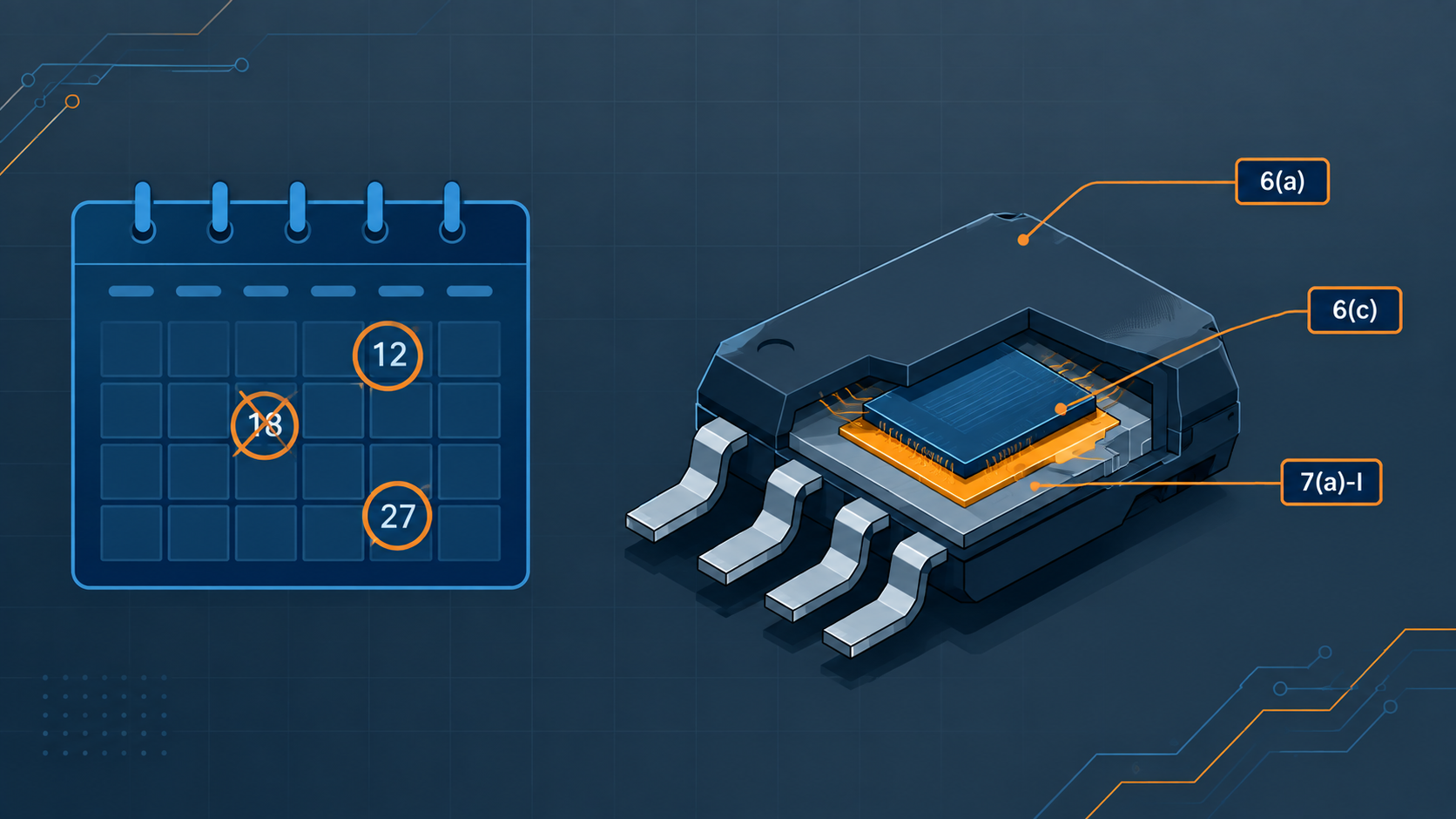
First, the series 7(a) entry that used to cover all high melting temperature solder in one line was broken into seven sub-entries, 7(a)-I through 7(a)-VII, each tied to a specific application: die attach in semiconductor assembly, first level solder joints, second level joints such as ceramic BGA solder balls, hermetic seals between a ceramic package and a metal case, lamp interconnects, and audio transducers operating above 200 C. A supplier declaration that still says "covered by exemption 7(a)" without a roman numeral is now under-specified.
Second, the series 6 alloy exemptions were re-cut the same way, with sub-entries carrying different expiry dates for different product categories. The European Commission publishes the current implementation status and the consolidated exemption list on its RoHS Directive implementation page.
The date that matters is the day you place it on the market, not the day it was made
When an exemption expires, the restriction applies from that date to every unit you place on the EU market afterwards, regardless of when the component or the finished product was manufactured. There is no grandfathering for stock already sitting in your warehouse. This is the single most expensive misreading of RoHS expiry dates, and it is exactly backwards from how most buyers think about date codes and shelf life.
The practical consequence: a reel bought in 2026 under exemption 6(a) is fine in a product you ship in November 2026 and a problem in the identical product you ship in January 2027. If you are placing a last-time buy against an expiring exemption, the quantity you can actually use is bounded by your shipping schedule, not by the component's date code and shelf life.
Which lead exemptions your parts most likely sit under
Five entries cover the overwhelming majority of what an electronics buyer touches. The dates below are the ones set by the November 2025 directives, current as of September 2026.
| Annex III entry | What it covers | Where you meet it | Expiry |
|---|---|---|---|
| 6(a) | Lead as an alloying element in steel for machining, up to 0,35 % by weight, and galvanised steel | Connector shells, screws, brackets, chassis hardware | 11 December 2026 |
| 6(b) | Lead as an alloying element in aluminium, up to 0,4 % by weight | Heatsinks, machined housings, RF enclosures | 11 June 2027, with sub-entries split by product category |
| 6(c) | Copper alloy containing up to 4 % lead by weight | Connector contacts, terminals, busbars, machined brass parts | 30 June 2027 |
| 7(a) and 7(a)-I to 7(a)-VII | Lead in high melting temperature solder, alloys containing 85 % or more lead | Die attach inside power semiconductors, ceramic BGA balls, hermetic seals | 30 June 2027 for the base entry, 31 December 2027 for the sub-entries |
| 7(c)-I | Lead in glass or ceramic other than capacitor dielectric, including piezo devices | Crystals, piezo buzzers, glass-sealed diodes, thick-film networks | 30 June 2027 |
Notice where these land. Exemptions 6(c) and 7(c)-I sit inside ordinary passives and connectors that nobody flags as a compliance risk, and 7(a) sits inside the package of almost every discrete power semiconductor you buy. If your compliance file only tracks exemptions for medical or aerospace lines, it is tracking the wrong ones.
The rolling plan rule that keeps an expired exemption alive
An exemption whose renewal was requested on time stays valid past its stated expiry date until the Commission takes a decision. Article 5(5) of the RoHS Directive requires the application to be filed no later than 18 months before expiry; once it is filed, the entry continues to apply throughout the review, which routinely runs years past the printed date. A renewal application covering 7(a) and its seven sub-entries was submitted on 12 December 2025, which is why those 2027 dates should be read as provisional rather than final.
This cuts both ways, and the asymmetry is the gotcha. A printed expiry date is not a deadline you can plan a redesign around, because it may quietly move out by two years. But it is also not permission to relax: if no renewal was filed, the date is hard. Exemption 6(a) is the one to remember, because it expires on 11 December 2026 without a renewal path, which means steel hardware relying on it needs a substitution decision this year. The status of every pending request is published on the Commission's RoHS exemption evaluation and consultation platform, and that page, not the directive text, is the one to check before you commit a redesign budget.
Worked example: a 1200 V IGBT from stock with a 2021 date code
Take a real line from our catalogue. The Infineon (International Rectifier) IRG4BH20K-STRLP, a 1200 V IGBT in a D-PAK-3 package, is discontinued, and the stock we hold carries a 21+ date code with 2,800 units available as of September 2026. It is the classic obsolescence buy: no replacement is coming, so whatever you take now has to carry the design.
Run the five questions against it. The die inside that package is attached with high lead solder, so the relevant entry is 7(a)-I, not the bare 7(a) that older declarations cite. That sub-entry is dated 31 December 2027, currently suspended pending the December 2025 renewal. The D-PAK lead frame is plated, not leaded steel, so 6(a) does not apply. The part number carries no PbF suffix, which International Rectifier used to mark its lead-free builds, so you cannot infer the answer from the ordering code and have to ask; the logic behind those markings is in our part number suffix decoder.
The verdict for this part is that it is buyable and declarable today, provided the supplier names 7(a)-I in writing. The verdict changes the moment your quantity has to cover shipments past a decision on the pending renewal, which is a conversation to have with the design team now rather than in 2028. That is the same discipline a product change or EOL notice demands, applied to a regulation instead of a manufacturer.
Four lines to add to your RoHS declaration request
Most supplier RoHS declarations are useless here because they answer a yes or no question that the exemption regime does not ask. Send these four requirements with the RFQ, not after the parts arrive.
- Name the exemption with its sub-entry. "Exempt under Annex III 7(a)" is not an answer in 2026. "7(a)-I, die attach" is. Anything without a roman numeral on the series 6 and 7 entries should go back.
- State the homogeneous material. The exemption applies to a material inside the part, not to the part. Ask which material carries the lead: die attach solder, contact alloy, glass seal.
- Ask for the manufacturer's own statement, not the reseller's. A blanket declaration from a trader carries no traceability. You want the document the manufacturer issued, delivered alongside the certificate of conformance.
- Date the declaration. A statement issued before 1 July 2026 predates the current Annex III and cannot have used the new sub-entry numbering. Treat anything older as needing re-confirmation.
The same request covers REACH SVHC disclosure if you ask for both in one line, which is worth doing because the supplier has to open the same file either way. The broader mechanics of RoHS scope, the ten restricted substances and CE marking are in our RoHS compliance guide for electronic components.
Your 2026 and 2027 exemption calendar
Three dates decide what you do between now and the end of 2027. Put them in the BOM review, not in a compliance folder nobody opens.
Before 11 December 2026. Identify every part relying on 6(a) leaded or galvanised steel. No renewal is pending, so this one is real. Connector shells and mounting hardware are the usual culprits, and they are also the easiest to second source, because the alternative is a standard part rather than a silicon redesign.
Through mid-2027. Map 6(b), 6(c) and 7(c)-I across the BOM and get sub-entry level declarations on file. Nothing needs to change yet, but you want the evidence gathered before a renewal decision forces a fast answer. Parts already flagged as obsolete deserve priority, since a last-time buy on an obsolete part locks in whatever exemption position it carries.
Watch, do not plan around, the 2027 solder dates. The 7(a) family is under review and those dates will most likely move. Track the consultation rather than budgeting a redesign against a date that is not yet final.
If a declaration comes back vague, or the part you need is only available from remaining stock and you want the exemption position pinned down before committing, that is the kind of question our sourcing desk answers with the manufacturer paperwork attached. Send us the part numbers and we will come back inside 24 hours with availability and the compliance documentation together.