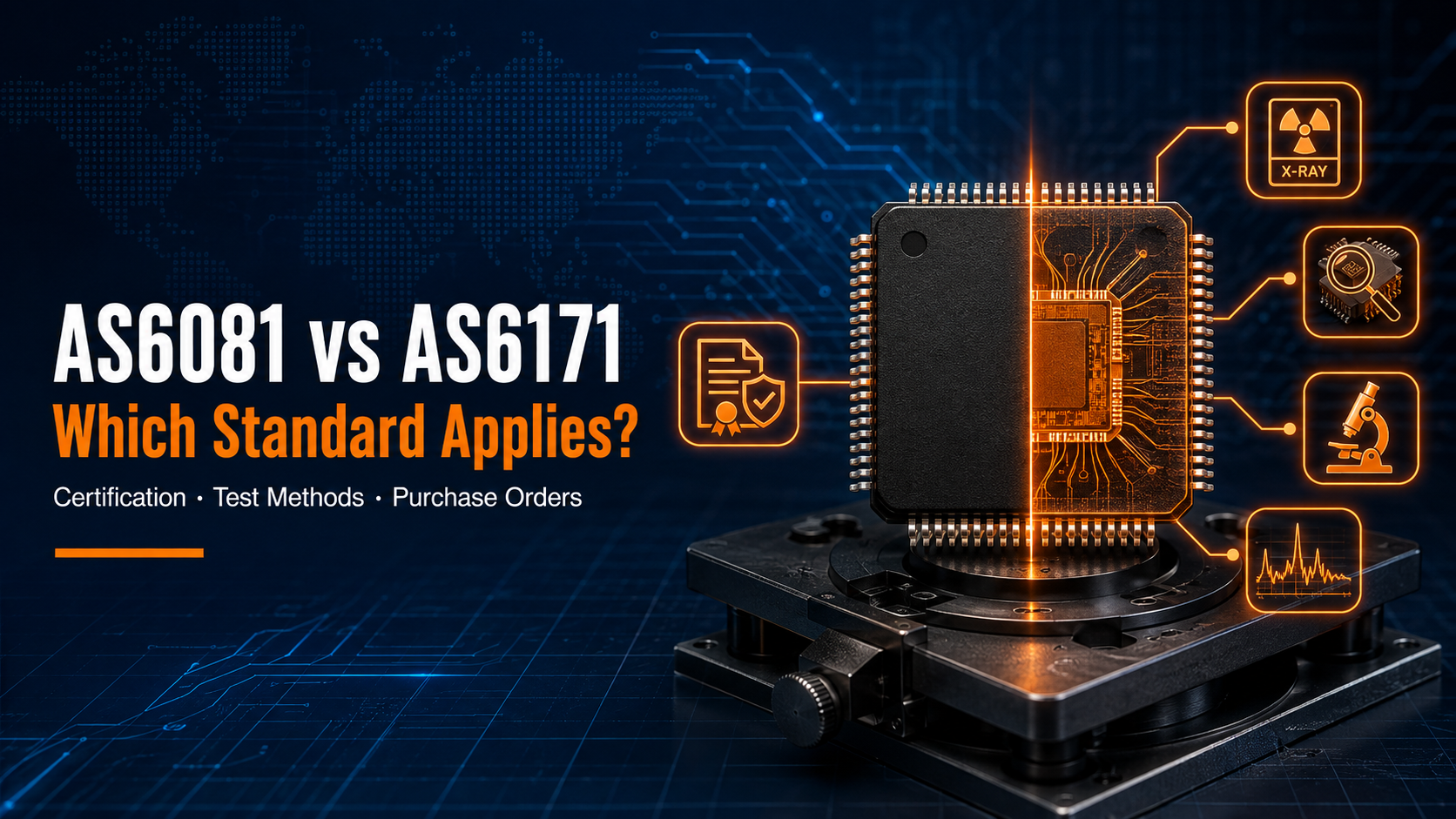
AS6081 and AS6171 are not competing standards and you do not choose between them. AS6081 is the counterfeit avoidance standard a distributor is audited and certified against. AS6171 is the library of test methods used to actually inspect the parts. A properly qualified independent distributor operates an AS6081 system and calls AS6171 methods when the risk assessment demands them.
That distinction sounds academic until it costs you an order. European buyers routinely write "must be AS6171 certified" into a purchase order, receive a polite refusal from every serious supplier, and conclude the market is being evasive. It is not. Nobody is certified to AS6171, because AS6171 does not certify companies. Here is what each document does, who it binds, and what to demand instead.
What AS6081 actually requires
SAE published AS6081 in 2012 specifically for independent distributors buying on the open market, which is the exact channel you use when a part is obsolete, allocated, or carries a 52 week factory lead time. It is two things at once: a quality management system for counterfeit avoidance, and a mandated inspection flow for parts that arrive without unbroken traceability to the original manufacturer.
The inspection flow is risk based. AS6081 defines three inspection levels, A, B and C, chosen from a documented assessment of the source and the part. Sample sizes are keyed to lot size, with the threshold set between lots of 1 to 199 devices and lots of 200 or more. A low risk source with full manufacturer traceability sits at the light end. A part bought from an unknown broker with no paper trail sits at the heavy end and gets the full workup.
A typical AS6081 sequence runs: documentation and packaging inspection, external visual inspection against IDEA-STD-1010, a remarking and resurfacing test using solvents, X-ray radiography, XRF for lead finish and material verification, decapsulation, and electrical test. The important word is sequence. Each step is a gate. A lot that fails external visual never reaches the electrical bench, which is how the standard keeps testing cost proportionate to risk.
When a supplier says it is "AS6081 certified", ask which body audited it. Certification is granted against AS6301, the verification criteria written to audit AS6081 conformance. A supplier that cannot name its certification body or produce a current certificate is describing an aspiration, not an audit.
What AS6171 actually is
AS6171 arrived in 2016 and solved a different problem. Before it, two laboratories could both claim to perform "X-ray inspection" and run wildly different procedures with incomparable results. AS6171 standardises the methods themselves, so a test report from one lab means the same thing as a test report from another.
It is published as a parent document plus slash sheets. AS6171/1 defines the risk based method for deciding which tests to run at all. The remaining sheets define individual techniques, including external visual inspection, X-ray radiography, X-ray fluorescence, acoustic microscopy, delid and decapsulation physical analysis, electrical test, Raman spectroscopy, FTIR, thermogravimetric analysis, and design recovery.
AS6171 binds whoever performs the testing. That may be an in house laboratory at a distributor, an independent test house, or your own incoming inspection department. It says nothing about how the parts were purchased, stored, or documented, which is precisely why it cannot replace AS6081.
The standards, side by side
| Standard | Who it binds | What it governs | Certifiable? | Ask for it when |
|---|---|---|---|---|
| AS6081 | Independent distributors | Counterfeit avoidance system plus a mandated risk based inspection flow for open market parts | Yes, audited against AS6301 | You are buying anything outside the authorised chain |
| AS6171 | Whoever runs the tests | Standardised test methods and the risk based logic for selecting them | No, it is a methods standard | You want test reports that are comparable between labs |
| AS5553 | OEMs, EMS providers, integrators | Your own counterfeit avoidance and control plan | Yes | A prime contractor flows counterfeit requirements down to you |
| AS6496 | Authorised and franchised distributors | Counterfeit avoidance inside the authorised channel | Yes | You are auditing a franchised distributor, not a broker |
| EN 9120 | Aerospace distributors in Europe | General distributor quality management | Yes | You need aerospace QMS assurance, not counterfeit testing |
Four mistakes European buyers keep making
Treating EN 9120 as counterfeit cover. EN 9120 is a distributor quality system standard. It governs traceability, records and control. It does not require a single counterfeit test. A supplier can hold a clean EN 9120 certificate and have no detection capability whatsoever.
Demanding AS6171 certification. This does not exist. What you can legitimately require is that any testing performed is conducted to AS6171 methods, and that the report cites the method used for each result.
Accepting a certificate of conformance in place of a test report. A CoC states what the supplier believes about the part. A test report states what somebody measured. For open market purchases you want both, and you want them to agree. Our guide to what a certificate of conformance must contain covers the fields that make a CoC verifiable rather than decorative.
Ordering the full test slate on a tiny lot. Decapsulation and physical analysis are destructive. On a 12 piece obsolete buy, a full workup can consume a quarter of your inventory and cost more than the parts themselves. This is the trade off nobody puts in the brochure: a full multi method AS6171 workup commonly runs from several hundred to a few thousand euros per lot and takes days, while a documentation, visual and remarking screen is measured in hours. Match the depth to the risk and the lot size, which is exactly what AS6081 level selection forces you to do.
What to write into the purchase order
Replace the vague clause with three specific ones. First, require the supplier to operate a counterfeit avoidance system conforming to AS6081 and to state its certification body. Second, require that any inspection or test is performed to AS6171 methods, with each method identified in the report. Third, require full documentation: the CoC, traceability back to the source, date and lot codes, and photographs of the parts as received.
Then decide the inspection level yourself rather than leaving it to the supplier. If the part has unbroken manufacturer traceability, a light screen is defensible. If it came from the open market with a thin paper trail, insist on the escalated flow and accept the cost. The decision belongs to whoever carries the field failure risk, and that is you.
If you are still choosing a channel, the trade offs between franchised and independent distribution determine which of these standards even applies to your supplier. And if you want the detection tactics rather than the standards framework, our guide on how to avoid counterfeit electronic components covers what to inspect at goods in.
How GlobX handles open market parts
GlobX operates as an independent distributor based in Germany, so the AS6081 framework describes our side of the transaction rather than a theoretical one. Every open market lot is risk assessed before it ships: source traceability first, then documentation and packaging, external visual, and escalation to X-ray, XRF, decapsulation or electrical test where the assessment calls for it. We scale the inspection to the risk and the lot size instead of applying one blanket procedure, and we tell you which level was applied and why.
Parts that are moisture sensitive are handled to their MSL requirements alongside the counterfeit screen, because a genuine part destroyed by popcorning in reflow fails just as expensively as a fake one.
Send us a part number or a shortage list and we will quote with the traceability and inspection scope stated up front. Talk to our sourcing team or browse available stock to start.
What this looks like in practice: our documented inspection process and certificates.