RoHS compliance is often treated as a regulatory checkbox, but for OEM and EMS buyers it is really a sourcing problem. Knowing that a part must be RoHS compliant is easy; proving that every component on your bill of materials actually is, especially when you buy from distributors or the open market, is where compliance is won or lost. This guide explains what RoHS compliance means and, more importantly, how European procurement teams source and verify RoHS-compliant electronic components.
What is RoHS compliance?
RoHS (Restriction of Hazardous Substances) is an EU directive that limits the use of specific hazardous materials in electrical and electronic equipment (EEE) sold in the European market. The current framework is RoHS 2 (Directive 2011/65/EU), extended by RoHS 3 (Directive (EU) 2015/863), which added four phthalates to the original six restricted substances. The European Commission keeps the consolidated texts and the current exemption decisions on its RoHS Directive page. A product is RoHS compliant when none of its homogeneous materials exceed the allowed concentration limits, and the manufacturer can prove it through a Declaration of Conformity and CE marking.
The 10 RoHS restricted substances
RoHS 3 restricts ten substances. The limit is 0.1% by weight (1000 ppm) in any homogeneous material, except cadmium at 0.01% (100 ppm).
| Substance | Limit |
|---|---|
| Lead (Pb) | 0.1% |
| Mercury (Hg) | 0.1% |
| Cadmium (Cd) | 0.01% |
| Hexavalent chromium (Cr6+) | 0.1% |
| Polybrominated biphenyls (PBB) | 0.1% |
| Polybrominated diphenyl ethers (PBDE) | 0.1% |
| Bis(2-ethylhexyl) phthalate (DEHP) | 0.1% |
| Butyl benzyl phthalate (BBP) | 0.1% |
| Dibutyl phthalate (DBP) | 0.1% |
| Diisobutyl phthalate (DIBP) | 0.1% |
RoHS vs REACH: what is the difference?
RoHS and REACH are both EU chemical regulations and are often confused. RoHS restricts ten specific hazardous substances in finished electrical and electronic equipment. REACH is far broader: it governs the registration and authorisation of all chemical substances, including a growing list of Substances of Very High Concern (SVHCs), across all products, not just electronics. In practice, a component sold into Europe usually needs to satisfy both. When you request compliance documentation, ask for RoHS and REACH (SVHC) statements together. For the buyer side of REACH, including the SVHC Candidate List, the 0.1% threshold and the SCIP database duty, see our guide to REACH compliance for electronic components.
Why RoHS compliance is really a sourcing problem
RoHS compliance fails at the sourcing step, not the design step: the restricted-substance list is fixed, but proving that every one of several hundred part numbers meets it, across every channel you bought from, is where products get blocked. For an EU manufacturer, the regulation is the easy part. Authorised distributors pass manufacturer documentation through cleanly, but during shortages and allocation, buyers turn to the open market, where date codes, sources and documentation vary. A single non-compliant or undocumented part can block CE marking for the whole product and trigger a recall. This is where sourcing discipline, not just regulatory knowledge, protects you.
How to source and verify RoHS-compliant electronic components
You source RoHS-compliant components by making six documents and checks a condition of every order, and by applying them hardest to open-market buys:
- Demand a RoHS Declaration of Conformity for each part, ideally referencing the manufacturer and the specific directive (2011/65/EU and 2015/863).
- Request a Certificate of Compliance (CoC) (our guide to the certificate of conformance shows what a usable one contains) and, for high-risk applications, a full material declaration (material content / IPC-1752A) so you can see substance-level data.
- Get RoHS and REACH (SVHC) statements together to avoid a second compliance gap.
- Verify the source and traceability. Insist on the supply chain back to the manufacturer, original packaging and date codes; the same checks catch most counterfeit components. A BOM evaluation flags which lines carry the most compliance and counterfeit risk.
- Buy from vetted channels. When the authorised channel is on allocation, use a verified independent distributor that applies ISO 9001 checks rather than an anonymous broker. See our guide on franchised vs independent distributors.
- Keep the documentation on file as part of your technical file; CE marking requires you to retain conformity evidence for ten years.
RoHS exemptions and what they mean for buyers
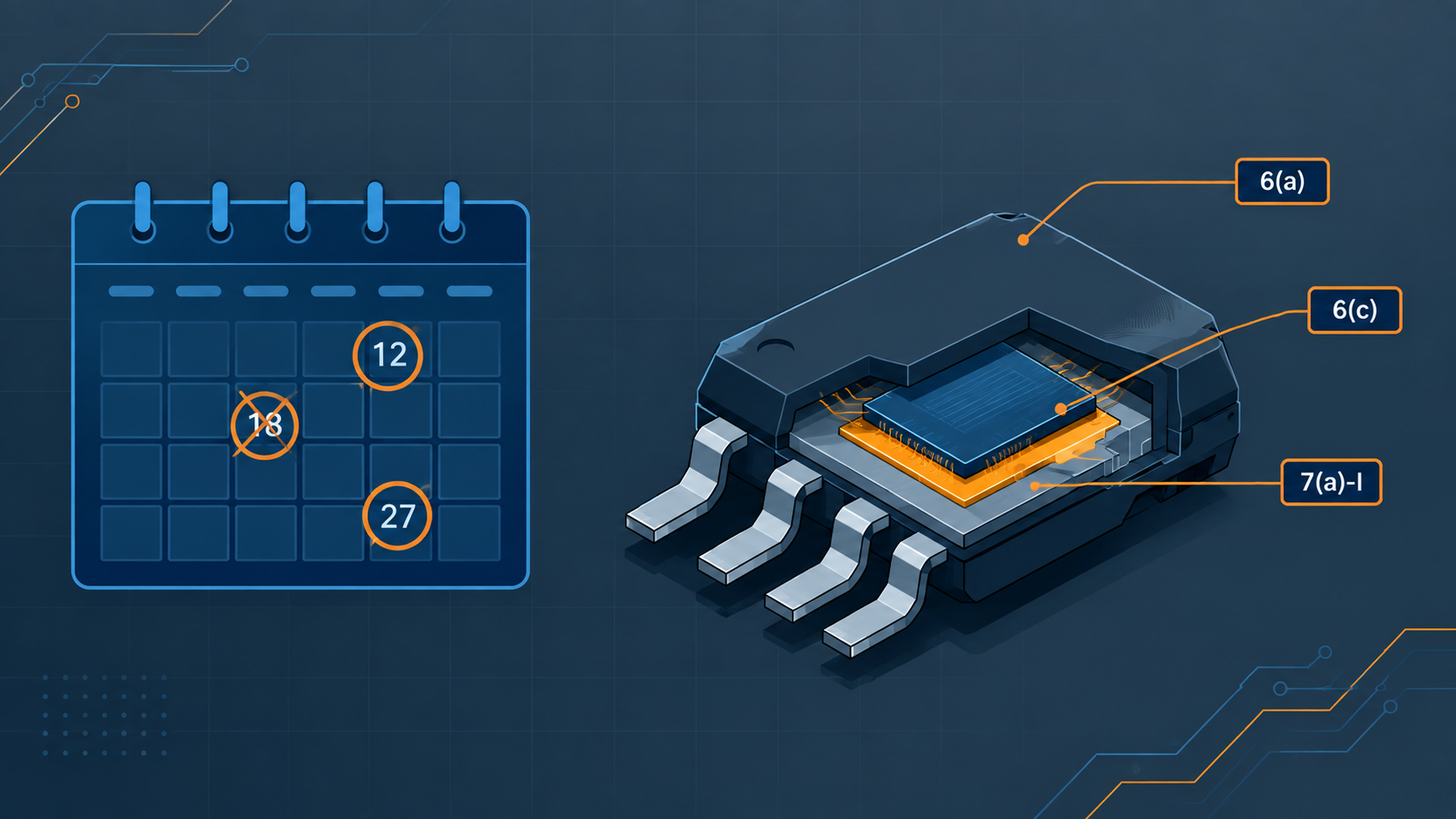
A RoHS exemption lets a part keep a restricted substance, usually lead, for a named use and a limited time, so a part can be compliant today and non-compliant after its exemption date. Some applications hold time-limited exemptions (for example certain lead uses in specific industrial, medical or aerospace equipment). Exemptions expire and are reviewed, so never assume a part is covered indefinitely. As of September 2026 this is live, not theoretical: rewritten Annex III lead exemptions apply from 1 July 2026, and exemption 6(a) for lead in steel expires on 11 December 2026. Our guide to RoHS exemptions expiring in 2026 lists the dates and the questions to ask before you accept stock. If a component relies on an exemption, document which exemption applies and track its expiry, because a lapsed exemption quietly turns a compliant part into a non-compliant one.
How GlobX helps
GlobX is a Europe-based independent distributor headquartered near Frankfurt, Germany. We source electronic components for OEM and EMS teams with the documentation and traceability that EU compliance demands: RoHS and REACH statements, Certificates of Compliance, ISO 9001 quality checks and full source traceability to keep non-compliant and counterfeit parts out of your build. Whether you are fighting a shortage or filling a hard-to-find line, we deliver compliant parts across the EU and beyond. Browse the live components catalogue or see our sourcing services.
Need RoHS and REACH documentation on a specific part, or a compliant source for an allocated component? Talk to the GlobX sourcing team for a 24-hour quote.