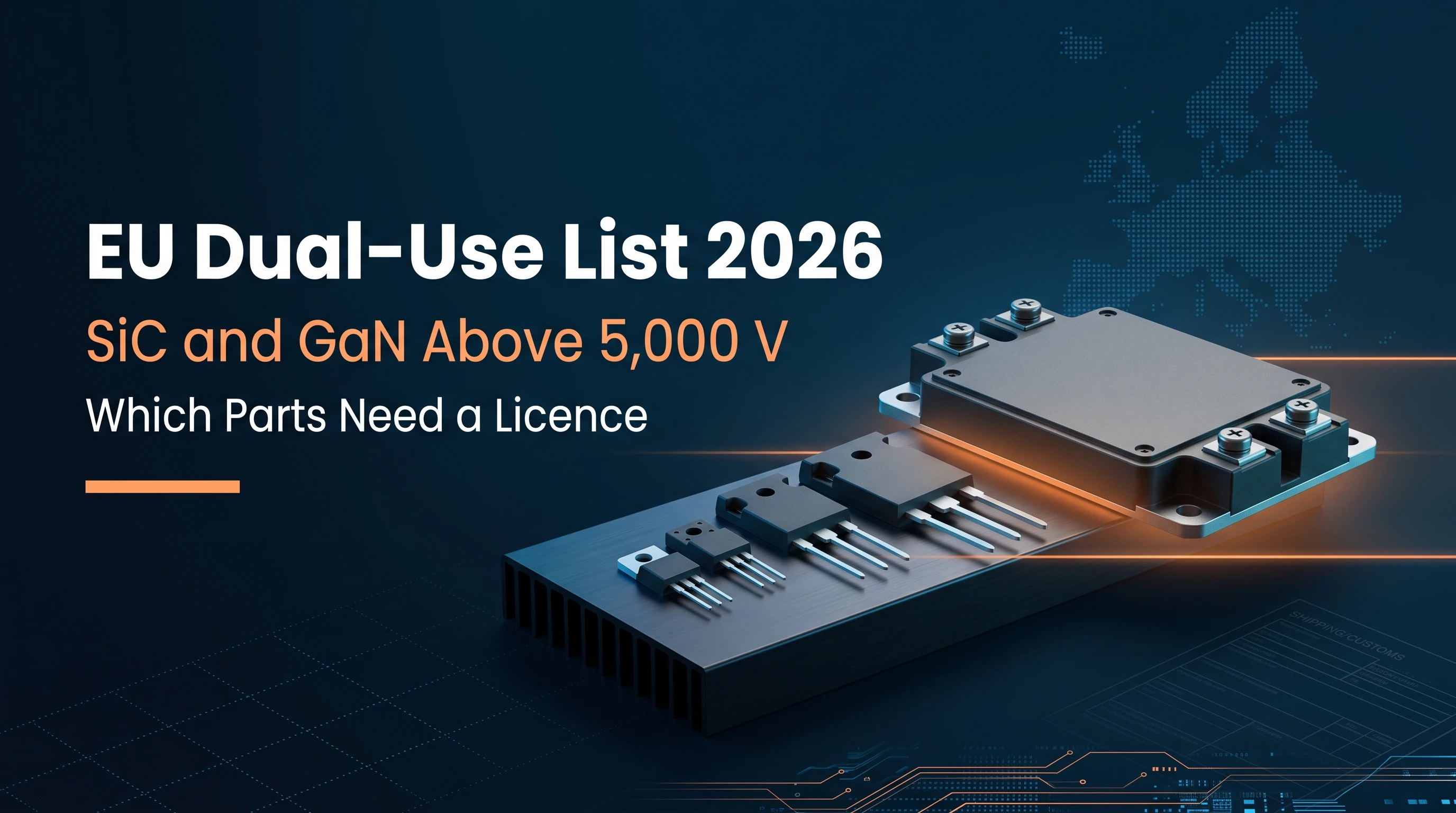
On 14 September 2026 the European Commission adopted Delegated Regulation C(2026) 6323, the yearly update of Annex I to the EU Dual-Use Regulation (EU) 2021/821. For component buyers the entry that matters is the new 3A501.h: silicon carbide, gallium nitride and gallium oxide power switches, diodes and modules with a blocking voltage above 5,000 V, a continuous current above 1 A and a semiconductor bandgap above 2.0 eV. As of October 2026 the act is still in the two-month scrutiny period and is expected to enter into force on publication in the Official Journal, which the Commission and trade lawyers place in November 2026. The short answer for most buyers: the 650 V, 1200 V and 1700 V SiC and GaN parts on a typical European BOM sit far below the line.
What did the 14 September 2026 update add for electronic components?
Three of the additions the Commission listed on 14 September touch the component trade directly: high-voltage wide-bandgap power devices (3A501.h), advanced-computing ICs (3A501.a.16) and small high-resolution inductive rotary encoders (3A501.f). A fourth entry in the same block of the 2026 annex, FPGA-based assemblies above a lookup-table threshold (3A502.i), matters to the same buyers. The "5" in 3A5xx marks EU-only controls outside the Wassenaar Arrangement numbering, so these entries do not appear on the US Commerce Control List under the same numbers. The thresholds below are quoted from the annex the Commission sent to the Council (Council document 13154/26 ADD 1) and the Commission's own announcement of the 2026 update.
| Entry | What it covers | Control thresholds (all must be met) | Who it reaches |
|---|---|---|---|
| 3A501.h (2026 addition) | Solid-state power switches, diodes and modules: MOSFETs, JFETs, IGBTs, HEMTs, thyristors, PiN and Schottky diodes | Blocking voltage above 5,000 V; continuous current above 1 A; bandgap above 2.0 eV; max junction temperature 215 C or lower | Buyers of 6.5 kV and 10 kV class SiC dies and modules, pulsed-power and medium-voltage research rigs |
| 3A001.h (existing) | The same device types, any material | Max junction temperature above 215 C; blocking voltage above 300 V; continuous current above 1 A | High-temperature downhole, aerospace and military power stages |
| 3A501.a.16 (2026 addition) | ICs with one or more digital processing units | Total Processing Performance (TPP) of 6,000 or more, or TPP 1,600 to 6,000 with performance density of 5.92 or more (data-centre parts only) | AI accelerators and data-centre GPUs, not MCUs or embedded SoCs |
| 3A501.f (2026 addition) | Absolute rotary inductive encoders not caught by 3A001.f | Digital output; outer diameter 40 mm or less; resolution 16 bits or more | Servo, robotics and gimbal builders |
| 3A502.i (in the 2026 annex) | Assemblies, modules or equipment with user-configurable FPGAs | Aggregate lookup-table input count of 1,800,000 or more | High-end FPGA boards, emulation and prototyping systems |
For 3A502.i the annex itself gives the arithmetic: a board with two FPGAs of 150,000 six-input LUTs each reaches 2 x 150,000 x 6 = 1,800,000 and is caught, while a loose FPGA chip is not an assembly.
Does your SiC or GaN part cross the 5,000 V line? A five-question test
A power device is caught by 3A501.h only if it answers yes to the first four questions below and no to the fifth, and almost every commercial SiC or GaN part fails at question two. Run the questions in order and stop at the first exit.
- Is the bandgap above 2.0 eV? Silicon (about 1.1 eV) exits here, so silicon IGBTs and superjunction MOSFETs are untouched. SiC (about 3.3 eV for the 4H polytype), GaN (about 3.4 eV) and gallium oxide (about 4.8 eV) continue. Note 4 of the entry names all three materials.
- Is the repetitive peak off-state voltage above 5,000 V? The annex counts drain-source, collector-emitter and repetitive peak reverse voltage. Commercial GaN HEMTs are mostly rated 100 V to 650 V, and catalogue SiC MOSFETs and diodes run in 650 V, 1200 V, 1700 V and 3300 V classes. Only the 6.5 kV, 10 kV and higher SiC devices, most of them sold as bare dies or press-pack and half-bridge modules, go on.
- Is the continuous current above 1 A? Every power module and nearly every discrete in this voltage class answers yes.
- Is the maximum junction temperature 215 C or lower? If it is higher, the part moves to the existing 3A001.h, which already controls devices above 300 V once junction temperature exceeds 215 C. Either way the part is listed.
- Is the device incorporated into equipment designed for a civil use the note exempts? Note 3 excludes devices built into equipment designed for civil automobile, civil railway, civil aircraft, civil power transmission and distribution, or civil energy conversion. A 6.5 kV module inside a grid converter shipped to a utility in Norway sits outside the entry.
The practitioner gotcha is in question five. The exemption is written for devices "incorporated into equipment", not for the device as a product. A loose 10 kV SiC module sold as a spare or as a development sample to a non-EU buyer is not inside any equipment at the moment of export, so a literal reading of the text keeps it in scope even when the buyer's end product is a civil inverter. Classification decisions of that kind belong to your export control officer and, for German exporters, to the licensing authority BAFA, not to a distributor's sales desk.
Worked example: a 1200 V automotive SiC MOSFET from GlobX stock
The STMicroelectronics SCT070H120G3AG is a 1200 V, 30 A automotive-grade silicon carbide MOSFET in H2PAK-7 with an on-resistance of 63 mOhm typical, and it fails the 3A501.h test at question two with 3,800 V to spare. GlobX holds 24,000 units of it as of October 2026, date code 21+, part status active, so it is a realistic line to run through the test:
- Question 1: SiC, bandgap well above 2.0 eV. Continue.
- Question 2: 1200 V blocking against a 5,000 V threshold. Exit: not caught by 3A501.h.
- Separately, the AG suffix marks an automotive part, and devices built into civil automobile equipment are excluded from both 3A501.h and 3A001.h by Note 3 anyway. Our part number suffix decoder covers what the trailing letters on codes like this one mean.
Compare a 6.5 kV SiC half-bridge module ordered by a research institute outside the EU for a pulsed-power test bench. It is wide-bandgap, above 5,000 V, above 1 A, and it ships loose rather than inside civil energy-conversion equipment. On the annex wording that line needs a licence check once the act is in force, and the classification should come from the manufacturer in writing before the order is confirmed. If you are weighing SiC against silicon for a new high-voltage design, the voltage class you choose now also decides whether this question ever reaches your purchasing team; our MOSFET vs IGBT comparison covers the electrical side of that trade-off.
ECCN, EU control entry, AL number or HS code: which code belongs on the quote?
Four different codes travel with an electronic component, and only two of them are export-control classifications. Mixing them up puts the wrong code in the wrong field of the export declaration.
- US ECCN (for example 3A001, 3A991 or EAR99) is the US Export Administration Regulations classification. It follows a US-origin part everywhere: a Texas Instruments IC resold from a warehouse in Germany still carries its US ECCN, and re-export to restricted destinations can still need a US licence.
- EU Annex I entry (for example 3A001.h or the new 3A501.h) is the EU classification under Regulation 2021/821. Wassenaar-based entries share their numbering with the US list; the 3A5xx entries exist only in the EU.
- German AL number (Ausfuhrlistennummer) is the field German exporters print on invoices. "AL: N" means the item is not on the EU list or the German national list. Expect it next to the ECCN on any invoice from a German distributor.
- HS / CN code (8541 for discrete semiconductors, 8542 for ICs) is the customs tariff code. It sets duty and statistics, and it says nothing about whether you need an export licence.
The classification itself has to come from the manufacturer, which is the party that knows the voltage, temperature and performance figures the entries test. A distributor can pass on the manufacturer's declaration with the certificate of conformance and the rest of the shipment documents, in the same way it passes on RoHS declarations. When an independent offer cannot show the manufacturer classification for a part near a threshold, treat that as the same warning sign as a missing CoC.
What should a European buyer do before the act takes effect in November 2026?
Most buyers need one afternoon: filter the BOM for wide-bandgap devices rated above 3,300 V, confirm their classification, and check where those parts ship after you. The checklist below covers the situations that actually generate licence questions.
- Filter the BOM by voltage class and material. Pull every SiC, GaN and gallium oxide line rated 3.3 kV or above; that is the only population that can reach 3A501.h. For most industrial and automotive BOMs the result is an empty list.
- Ask the manufacturer for the new EU entry, not just the US ECCN. Because 3A501.h is EU-only, a datasheet or portal showing "EAR99" does not answer the EU question for a 6.5 kV part.
- Map where the part goes after you. Shipments between EU member states, Germany to France for example, need no dual-use licence except for the short list of especially sensitive items in Annex IV of the regulation. The licence question arises when the part, or a spare of it, leaves the EU.
- Keep the catch-all in mind. Article 4 of the regulation can require a licence for items that are not listed at all, if the exporter is told or knows the end use is military or linked to weapons of mass destruction in an embargoed destination. A low-voltage part is not automatically free to go anywhere.
- Expect end-use statements on high-voltage SiC orders. Once the entry is in force, a responsible supplier will ask who uses a listed module and for what before it ships outside the EU. Have the end-user name, application and destination ready so the shipment does not wait while they are collected.
Separate rules keep running alongside the dual-use list: the EU sanctions on Russia under Regulation 833/2014 still require the "no re-export to Russia" clause for common high-priority items, which include most HS 8541 and 8542 semiconductors, and product rules such as the Cyber Resilience Act apply regardless of export status. If a high-voltage line on your BOM turns out to need a different part, our guide to checking a cross-reference before you approve it explains how to vet the alternative.
Sourcing SiC, GaN or silicon power devices for a European build and need the paperwork sorted from the first quote? Send the part numbers and destination to the GlobX team and we will quote with the manufacturer classification attached.