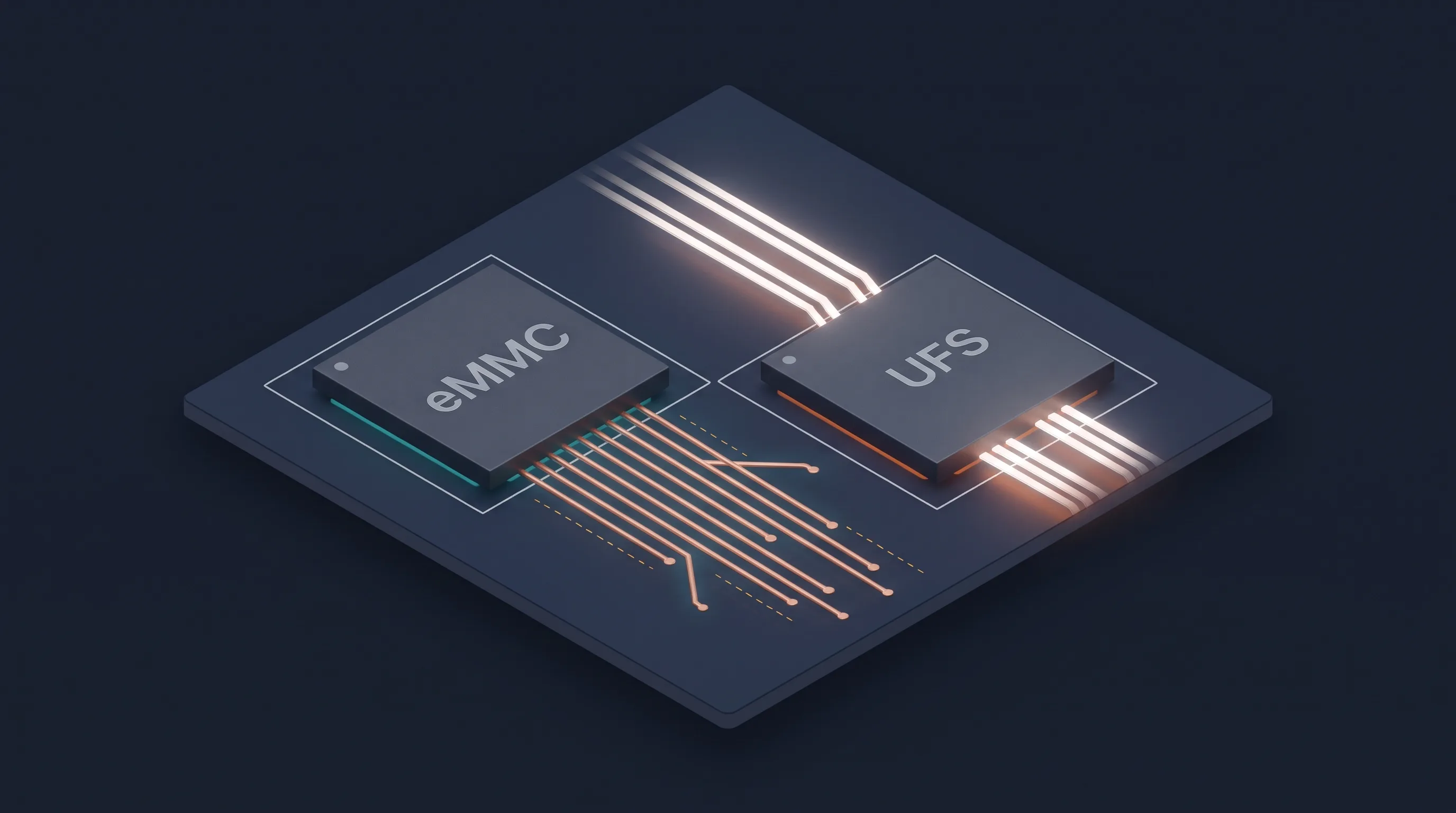
eMMC and UFS are both a NAND flash die and a controller sealed in one BGA package, and the difference that matters is the bus: eMMC 5.1 talks over an 8-bit parallel, half-duplex bus capped at 400 MB/s, while UFS uses serial MIPI M-PHY lanes that read and write at the same time, from about 1.2 GB/s (UFS 2.2) to about 5.8 GB/s (UFS 4.0) of raw interface bandwidth. For a phone, UFS wins on every axis. For an industrial controller, HMI or gateway that must ship unchanged for ten years, eMMC is still the safer buy in most cases, because the processor you already chose probably only speaks eMMC and the supplier base for industrial-temperature eMMC is far wider.
This guide compares the two the way a hardware engineer or buyer has to: interface, host support, endurance, supply in late 2026, and what a switch actually costs. It closes with three eMMC parts we hold in stock in Europe as of November 2026.
eMMC vs UFS at a glance: the comparison chart
The chart below lines up eMMC 5.1 against the three UFS generations you will meet in datasheets today. Interface figures are raw bus limits from the JEDEC standards (JESD84-B51 for eMMC 5.1 and the JEDEC UFS family); real parts land below them, and small-capacity parts land well below them on writes.
| Attribute | eMMC 5.1 | UFS 2.2 | UFS 3.1 | UFS 4.0 |
|---|---|---|---|---|
| Bus type | 8-bit parallel, single-ended | 2-lane serial, differential | 2-lane serial, differential | 2-lane serial, differential |
| Duplex | Half (read or write) | Full (read and write) | Full | Full |
| Max interface rate | 400 MB/s (HS400) | ~1.2 GB/s (HS-G3) | ~2.3 GB/s (HS-G4) | ~5.8 GB/s (HS-G5) |
| Typical sequential read, real parts | 250-330 MB/s | ~800-1,000 MB/s | ~1,700-2,100 MB/s | ~4,000-4,200 MB/s |
| Common capacities | 4-256 GB | 32-256 GB | 64-512 GB | 128 GB-1 TB |
| Industrial / automotive temperature grades | Many vendors, -40 to +85/+105 °C | Few | Few, mostly automotive-qualified | Very few |
| Host support in MPUs (i.MX 8M, AM62x, STM32MP1, RK3568) | Yes | No | No | No |
| Health reporting | EXT_CSD life-time and pre-EOL registers | Health descriptor | Health descriptor | Health descriptor |
Read the table from the bottom up when you are designing industrial equipment. Host support and temperature grades decide the shortlist long before speed does.
Why UFS is faster: serial lanes vs an 8-bit parallel bus
UFS is faster because it moves data over differential serial lanes in both directions at once, while eMMC pushes everything through one shared 8-bit bus that can either read or write at any moment. The eMMC bus at HS400 runs 8 data lines at 200 MHz with double data rate, which is where the 400 MB/s ceiling comes from. UFS 3.1 runs two lanes per direction at 11.6 Gbit/s each, so a log write and a firmware read no longer queue behind each other.
For embedded loads the gap that users feel is random I/O, not peak sequential speed. "Why is eMMC so slow" is one of the most-searched questions about it, and the usual answer is small random writes: a Linux system writing journals, databases and logs in 4 KB chunks to an 8 GB eMMC can drop to single-digit MB/s while the datasheet promises hundreds. UFS handles that pattern better thanks to its SCSI command set, deeper queuing and full duplex, but a well-configured eMMC with a sane filesystem (mount options, fewer sync calls, logs in RAM) closes much of the gap for a controller that does not stream video.
Your processor usually decides for you
On most industrial and embedded processors the choice is already made: the popular application processors (NXP i.MX 6 and i.MX 8M, TI AM335x and AM62x, ST STM32MP1, Rockchip RK3568) and the Raspberry Pi Compute Module 4 and 5 boot from eMMC and have no UFS host controller at all. UFS hosts live mainly in smartphone-derived SoCs from Qualcomm and MediaTek and in high-end automotive cockpit platforms.
That has a practical consequence for German and EU machine builders, where an HMI or PLC board is often designed around an i.MX or AM62x module and then built for 10-15 years. The storage question there is not "eMMC or UFS" but "which eMMC, from how many sources, in which temperature grade". UFS only enters the discussion when the platform itself moves to a new SoC generation, and then the storage swap rides along with a full redesign.
Endurance and lifespan: what actually wears out embedded flash
An eMMC or UFS device wears out when its NAND runs through its program/erase cycles, and the interface has almost nothing to do with it: lifespan depends on NAND type (SLC, MLC, TLC), capacity, write amplification and how much your software writes. A typical MLC eMMC is rated in the low thousands of P/E cycles per block, TLC lower still. A small device written constantly will die years before a large one with the same workload, because wear levelling has fewer blocks to spread the writes across.
The textbook case is automotive. In 2021 Tesla recalled about 135,000 Model S and Model X vehicles after the 8 GB eMMC in the media control unit wore out from continuous logging, which killed the touchscreen and with it the rear-view camera and defrost controls. Nothing was wrong with the eMMC; the device was simply too small for the write load it was given. The same mistake shows up in industrial gateways that log sensor data every second.
Three countermeasures work regardless of which interface you pick:
- Size for endurance, not for the image. If your OS image needs 3 GB, an 8 GB part may fit but a 16 or 32 GB part gives wear levelling several times more blocks to work with. The price step is usually small against a field failure.
- Use pSLC (enhanced user area) for write-heavy partitions. Configuring part of an MLC eMMC as pseudo-SLC halves the usable capacity of that area but raises its rated cycles by roughly an order of magnitude. The setting is one-time programmable, so it belongs in the production programming step, not in the field.
- Read the health registers. Since eMMC 5.0, the EXT_CSD registers PRE_EOL_INFO and DEVICE_LIFE_TIME_EST_TYP_A/B report wear in 10% steps. On Linux,
mmc extcsd read /dev/mmcblk0from mmc-utils shows them. UFS exposes the same information through its health descriptor. If your product never reads these, you will learn about wear from customer returns.
Supply and price in late 2026
As of November 2026, embedded flash is expensive but no longer climbing as fast as it was: TrendForce projected NAND contract prices up 15-20% quarter on quarter in 4Q26, driven by AI servers rather than phones (TrendForce, 30 September 2026). Its 4Q26 eMMC/UFS contract price outlook of 22 October 2026 has UFS increases narrowing to single digits and MLC eMMC prices dipping as buyers substitute TLC. That answers the other common question, "why is eMMC so expensive": the same NAND wafers that go into enterprise SSDs go into eMMC, and AI demand has priced them up all year.
For industrial buyers the price headline hides two supply risks that matter more:
- Low-capacity MLC eMMC is the shrinking corner. Memory makers are moving wafer capacity to high-layer TLC and QLC for SSDs and phones, and TrendForce's note that buyers are already substituting TLC for MLC eMMC shows where the market is heading. 4 GB and 8 GB MLC parts, exactly what many industrial boards were designed around, are the most exposed to discontinuation because they earn the least per wafer. If your board uses one, check its lifecycle status now and plan a last-time buy or a qualified 16 GB alternative before the notice arrives.
- Same part number, new firmware. eMMC suppliers revise controller firmware during a part's life, and the product revision field in the CID register changes while the ordering code does not. A new revision can change boot timing or default partition settings. Ask for the date code and firmware revision on every lot and requalify when it moves.
The same AI-driven squeeze is behind the DRAM side of most boards; our memory chip shortage 2026 report and the DDR4 EOL dates by maker cover it.
Worked example: three eMMC parts on our shelf in Europe
Here is what an industrial buyer replacing or second-sourcing a small eMMC can actually get from GlobX stock as of November 2026, with the trade-off of each:
- Kioxia THGBMJG6C1LBAU7: 8 GB (64 Gbit) eMMC 5.1, HS400, 153-ball WFBGA 11.5 x 13 mm, rated -40 to +105 °C, 6,000 units in stock, date code 22+, status Active. The widest temperature range of the three, which makes it the natural choice for outdoor or under-hood boards.
- SanDisk SDINBDG4-8G (iNAND 7250): 8 GB MLC eMMC 5.1 with HS400, -25 to +85 °C, date code 2026, status Active. The fresh date code suits buyers who need recent lots, but the -25 °C lower limit rules it out for cold-start industrial specs.
- MTFC4GLGDM-AIT A TR (Micron MTFC eMMC series): 4 GB, 3,900 units in stock, date code 21+, status Active, factory sealed. The right part for keeping a legacy 4 GB design running unchanged; the 21+ date code means checking storage conditions and, for opened reels, the MSL bake rules before reflow.
Two of the three share the 153-ball 11.5 x 13 mm outline that most eMMC uses, which is why switching between eMMC vendors is usually a firmware and qualification job, not a board respin. More parts are in our NAND flash category.
Moving from eMMC to UFS: what the switch really costs
Switching from eMMC to UFS is a board redesign, not a part swap: you need a processor with a UFS host, new routing for high-speed differential pairs, a different power rail set, new boot firmware and a new storage driver stack. Some UFS packages use a 153-ball outline close to eMMC's, which misleads people into expecting a drop-in; the ball functions are different, so the footprint does not carry over.
A realistic budget looks like this: a new SoC or module, a PCB layout pass with impedance-controlled lanes (UFS 3.1 and 4.0 lanes are in the multi-gigabit range and need the same care as PCIe), bootloader and kernel changes, and full requalification including EMC. For a product family that sells a few thousand units a year, that is rarely justified by storage speed alone. It is justified when the whole platform moves, when the eMMC sources for your capacity and temperature grade are drying up, or when the application (camera recording, AI inference with large models, fast boot of a big image) genuinely needs gigabytes per second.
If you are choosing between flash types at a lower level, for example code storage next to a microcontroller rather than a full filesystem, the NOR vs NAND flash guide is the better starting point. For automotive boards, check which AEC standard the storage part is actually qualified to; our AEC-Q100 vs AEC-Q101 explainer covers what "automotive grade" means on a datasheet.
Need a second source for an 8 GB eMMC, or a last-time-buy quantity of a 4 GB part your board cannot live without? Send us the part number, quantity and the date-code window you can accept, and we will quote stock and lead time within 24 hours.