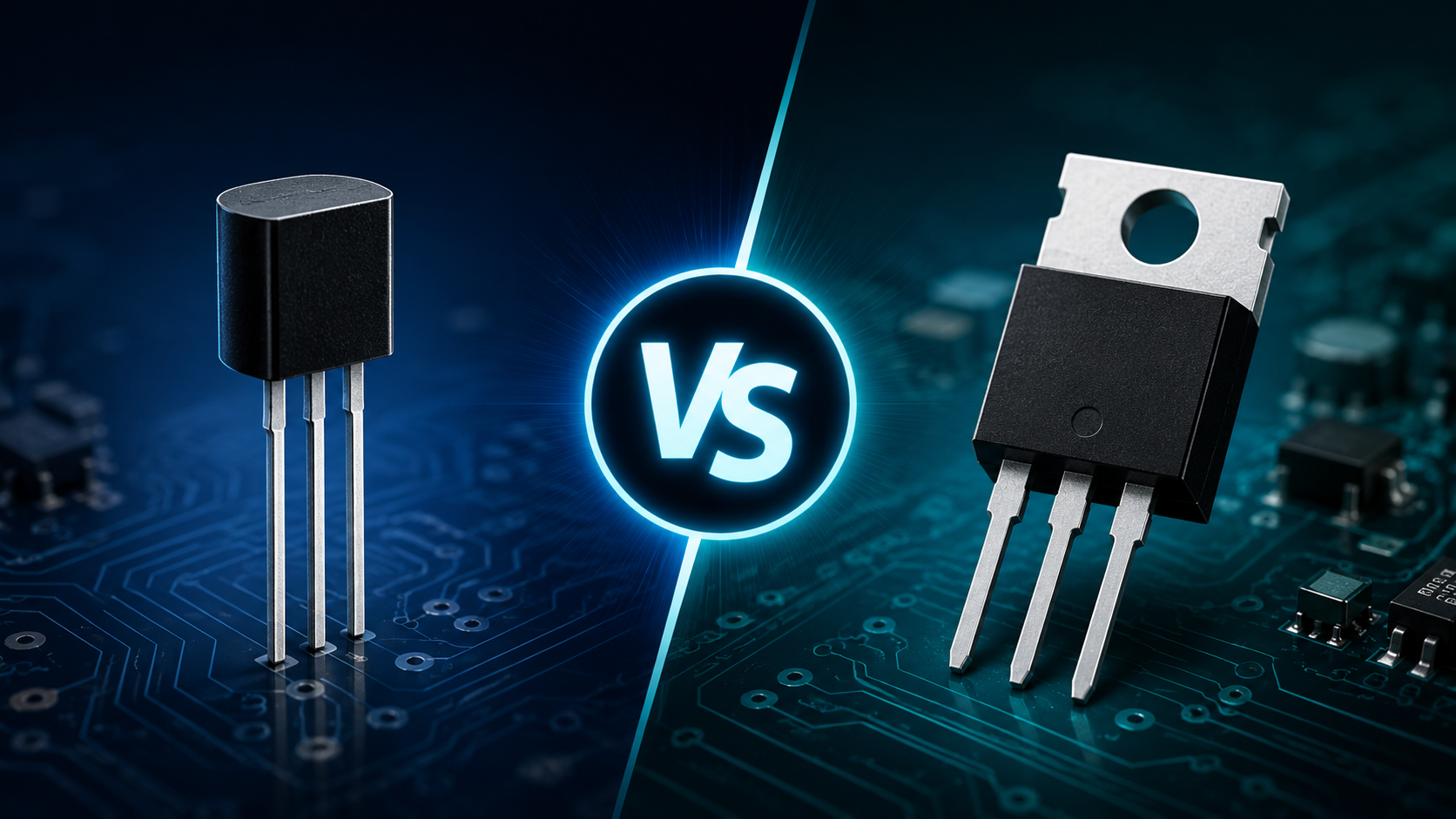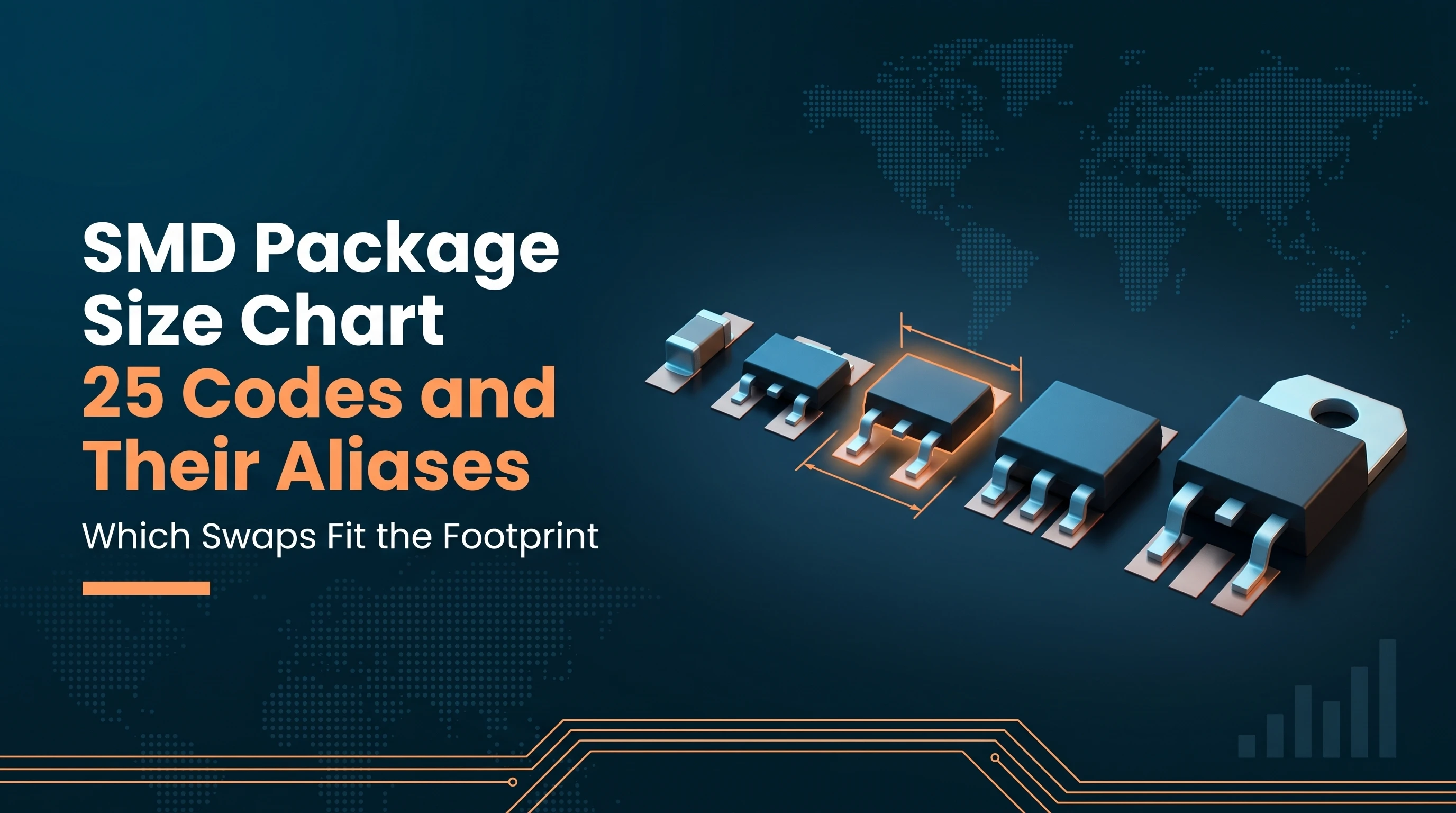
An SMD package code tells a buyer the body size and pad layout of a part, but the same body often carries three names: Nexperia's SOT23 is JEDEC TO-236AB, its SOT323 is JEITA SC-70, and its SOT363 is SC-88. Chip passives add a second trap: "0402" is 1.0 x 0.5 mm in the imperial (EIA) system and 0.4 x 0.2 mm in the metric one. The chart below lists 25 common SMD package codes with their aliases and real dimensions, plus the rules for telling a safe package swap from one that forces a board change. Dimensions are taken from Nexperia package outline documents and Murata size codes, checked in October 2026.
SMD chip size chart: imperial and metric codes side by side
Two-terminal chip resistors, MLCCs, chip inductors and ferrite beads use a four-digit size code, and every code exists in an imperial and a metric version. The imperial code gives length and width in hundredths of an inch (0603 = 0.06 x 0.03 in). The metric code gives them in tenths of a millimetre (1608 = 1.6 x 0.8 mm). European and US distributors and most BOMs use imperial. Japanese manufacturers often print metric, and Murata writes both in its own launches, for example "0603 inch (1608 mm)" in the DFE18SA inductor announcement.
| Imperial (EIA) code | Metric code | Nominal size (mm) | Typical resistor rating | Buyer note |
|---|---|---|---|---|
| 01005 | 0402 | 0.4 x 0.2 | 1/32 W | Wearables and modules; many EMS lines in Europe cannot place it |
| 0201 | 0603 | 0.6 x 0.3 | 1/20 W | Phones and RF modules; the metric code collides with imperial 0603 |
| 0402 | 1005 | 1.0 x 0.5 | 1/16 W | The default size on dense industrial boards |
| 0603 | 1608 | 1.6 x 0.8 | 1/10 W | The broadest stock for general passives |
| 0805 | 2012 | 2.0 x 1.25 | 1/8 W | Common in power and automotive designs |
| 1206 | 3216 | 3.2 x 1.6 | 1/4 W | Higher-voltage MLCCs, current-sense resistors |
| 1210 | 3225 | 3.2 x 2.5 | 1/3 to 1/2 W | Bulk MLCCs, often 10 µF and up |
| 1812 | 4532 | 4.5 x 3.2 | 3/4 W | High-voltage and safety-rated capacitors |
| 2512 | 6332 | 6.3 x 3.2 | 1 W | Power resistors and shunts |
The power ratings are typical values for standard thick-film resistors. Pulse-rated, anti-sulphur and wide-terminal versions of the same size often carry a different rating, so take the rating from the series datasheet and not from the size code.
The 0402 trap: one code, two parts six times apart in area
An RFQ line that reads only "0402" can be met with either of two parts. Imperial 0402 is 1.0 x 0.5 mm. Metric 0402 is 0.4 x 0.2 mm, which is imperial 01005: a footprint of 0.08 mm² against 0.5 mm², about one sixth of the area. The same collision exists for 0603: imperial 0603 (1.6 x 0.8 mm) against metric 0603 (0.6 x 0.3 mm, imperial 0201). Neither mistake can be reworked on the board. The parts are simply the wrong size for the pads.
The ordering code is safer than the size code, because each manufacturer embeds the case in its own way:
- Yageo uses the imperial code directly. CC0402JRNPO9BN330 is a 33 pF, 50 V NP0 capacitor in imperial 0402, and GlobX holds 189,000 pieces of it (date code 22+, factory sealed).
- Samsung Electro-Mechanics uses a two-digit case code: CL05 is 0402 and CL10 is 0603.
- Murata also uses two digits, but they come from the metric size: GRM15 is 1.0 x 0.5 mm (imperial 0402) and GRM18 is 1.6 x 0.8 mm (imperial 0603).
- TDK prints the full metric code: C1005 is imperial 0402 and C1608 is imperial 0603.
The practical rule for any RFQ or purchase order is to write the size as "0402 imperial (1.0 x 0.5 mm)", or to quote the full ordering code, which removes the ambiguity. The same discipline applies to the rest of the ordering code, and our part number suffix decoder shows where the case, tolerance and packaging letters sit for seven chipmakers.
Transistor, diode and power package aliases: one body, up to three names
Semiconductor packages carry a manufacturer code (Nexperia SOT, onsemi case numbers), a JEDEC outline (TO-236, TO-252) and often a Japanese JEITA name (SC-59, SC-70). Distributor filters mix all three, so one part can appear under different package names on two websites. The table pairs the names and gives the nominal body from each package outline. The body and pitch figures for every SOT and DPAK row come from Nexperia's package information documents, for example the SOT23 outline.
| Common name | Also sold as | Leads | Nominal body (mm) | Same footprint as SOT-23? |
|---|---|---|---|---|
| SOT-23 (SOT-23-3) | TO-236AB | 3, 1.9 mm outer pitch | 2.9 x 1.3 x 1.0 | Reference |
| SC-59 (SOT346) | SC-59A, TO-236, SMT3, MPAK | 3, 1.9 mm outer pitch | 2.9 x 1.5 x 1.15 | Lands on it, but the body is not identical |
| TSOT-23 | Thin SOT-23 | 3, 5 or 6 | Thinner version of SOT-23 | Usually yes; check the land pattern in both datasheets |
| SOT-323 | SC-70, SC-70-3 | 3, 1.3 mm outer pitch | 2.0 x 1.25 x 0.95 | No |
| SOT-363 | SC-88, SC-70-6, TSSOP6 | 6, 0.65 mm pitch | 2.0 x 1.25 x up to 1.1 | No |
| SOT-753 | SC-74A, TSOP5, often "SOT-23-5" | 5, 0.95 mm pitch | 2.9 x 1.5 x 1.0 | No (5 leads) |
| SOT-457 | SC-74, TSOP6, often "SOT-23-6" or "SOT-26" | 6, 0.95 mm pitch | 2.9 x 1.5 x 1.0 | No (6 leads) |
| SOT-89 | TO-243, SC-62 | 3 plus tab, 1.5 mm pitch | 4.5 x 2.5 x 1.5 | No |
| SOT-223 | SC-73 | 3 plus tab, 2.3 mm pitch | 6.5 x 3.5 x 1.65 | No |
| DPAK (SOT428) | TO-252, SC-63 | 2 plus tab, 2.285 mm pitch | 6.0 x 6.6 x 2.3 | No |
| D2PAK (SOT404) | Commonly listed as TO-263 | 2 plus tab, 2.54 mm pitch | 11 x 10 x 4.3 | No |
| SOD-123F | Flat-lead SOD-123 | 2 | 2.6 x 1.6 x 1.1 | No (diode package) |
| SMA / SMB / SMC | DO-214AC / DO-214AA / DO-214AB | 2 | Three body sizes, smallest to largest | No (diode packages) |
| DFN1010D-3 (SOT1215) | Leadless, side-wettable flanks | 3, 0.75 mm pitch | 1.1 x 1.0 x 0.37 | No |
Together with the nine chip sizes above, that makes 25 package codes. The SC-59 row is the one buyers argue about most. Nexperia's SOT346 outline gives a 2.9 x 1.5 x 1.15 mm body against 2.9 x 1.3 x 1.0 mm for SOT23, on the same 1.9 mm lead pitch. Most SC-59 parts solder onto a SOT-23 land pattern without trouble. The body is still 0.2 mm wider and 0.15 mm taller, though, so the pick-and-place vision template and the AOI library entry may reject it. Rohm sells many of its small transistors in SMT3, which is this SC-59 body and not SOT-23.
Worked example: one BAV99 base number, four packages, two configurations
The BAV99 dual switching diode shows why a base part number without its package suffix is not a valid BOM line. Nexperia's BAV99 series datasheet lists three versions under one family name, and the BAV99QA datasheet adds a fourth:
- BAV99: SOT23 (TO-236AB), dual series pair, 250 mW.
- BAV99W: SOT323 (SC-70), dual series pair, 200 mW.
- BAV99S: SOT363 (SC-88), two series pairs in one 6-lead body.
- BAV99QA: DFN1010D-3, leadless, 0.37 mm high, AEC-Q101 qualified.
Three of these sit in GlobX stock as of October 2026, each with a different footprint:
- Diotec BAV99-Q is the SOT-23 version, rated 85 V and 0.21 A. Note that this is below Nexperia's 100 V rating for the same base number.
- Infineon BAV99S H6327 is the SOT-363 quad version, with 18,000 pieces in stock at date code 22+.
- Nexperia BAV99QAZ is the DFN1010D-3 version.
Suppose a buyer gets the line "BAV99, qty 18,000" and fills it with the Infineon stock because the base number matches. The result is a 6-lead part for a 3-pad footprint. Nothing about that order is counterfeit, and none of it can be fitted. Before any of the three goes on a purchase order, the BOM needs the full ordering code, and the reasons are set out in our guide to checking a cross-reference before you buy.
Which package swaps fit, and which force a board change
A package swap is only safe when the land pattern, the pin function and the assembly process all stay the same. The decision rule has three tiers:
- Same outline, different name. SOT-23 and TO-236AB, SOT-323 and SC-70, and DPAK and TO-252 are each one outline. You can approve the swap on paper once the pinout matches.
- Same land pattern, different body. SC-59 on a SOT-23 footprint, TSOT-23 on SOT-23, and SOD-123F against SOD-123 all need an engineering check of the datasheet land pattern and one assembly trial. The question here is placement, height and the solder fillet, not electrical behaviour.
- Different land pattern. SOT-23 to SOT-323, 0402 to 0603, SOT-223 to DPAK and any leaded part to DFN all mean a PCB revision, however close the electrical specs are.
The gotcha that a package chart does not show is the pinout. The SOT-23 outline fixes where the three pads are, not what each pin does. Most small-signal MOSFETs put gate on pin 1, source on pin 2 and drain on pin 3, while bipolar transistors follow base, emitter, collector. A few parts mirror the order. A drop-in on the outline can therefore still be a wiring error, so compare the pin table, not just the package name.
The 2026 MLCC shortage makes the third tier tempting. As of September 2026, high-capacitance MLCCs (roughly 10 µF and up in 0402 to 0805) were among the tightest lines, with high-specification lead times reported at up to about 40 weeks. Sizing a 10 µF part up from 0402 to 0603 looks like an easy fix, but it is a footprint change and needs a layout revision. Our MLCC shortage guide lists the substitutes that keep the original case size.
How to state a package on an RFQ so the right part ships
An RFQ line names the package without ambiguity when it carries four things:
- The full manufacturer ordering code, including the package and packaging suffix (BAV99W,115 and not BAV99).
- The package by both names where an alias exists, for example "SOT-323 / SC-70".
- For chip passives, the system and the dimensions, for example "0402 imperial, 1.0 x 0.5 mm".
- The packaging format: reel, cut tape or tray.
The packaging format matters because your EMS feeder setup decides whether loose cut tape is usable. Our tape and reel vs cut tape guide covers the minimums and leader length.
Leadless packages such as DFN and QFN add one more line to the purchase order: the moisture sensitivity level and the bag seal date, because these bodies are the ones most often shipped with an expired dry pack. The thresholds are in our MSL guide.
When a part arrives, the package is also the first counterfeit check. A body that measures 0.2 mm off the datasheet outline, or a marking code that does not match the package variant ordered, is a reason to quarantine the lot. Our counterfeit avoidance guide lists the inspections that follow.
If a BOM line names a family but not a package, send it to GlobX with the board footprint you need. We will confirm which ordering code fits that land pattern and quote traceable stock from Europe within 24 hours.