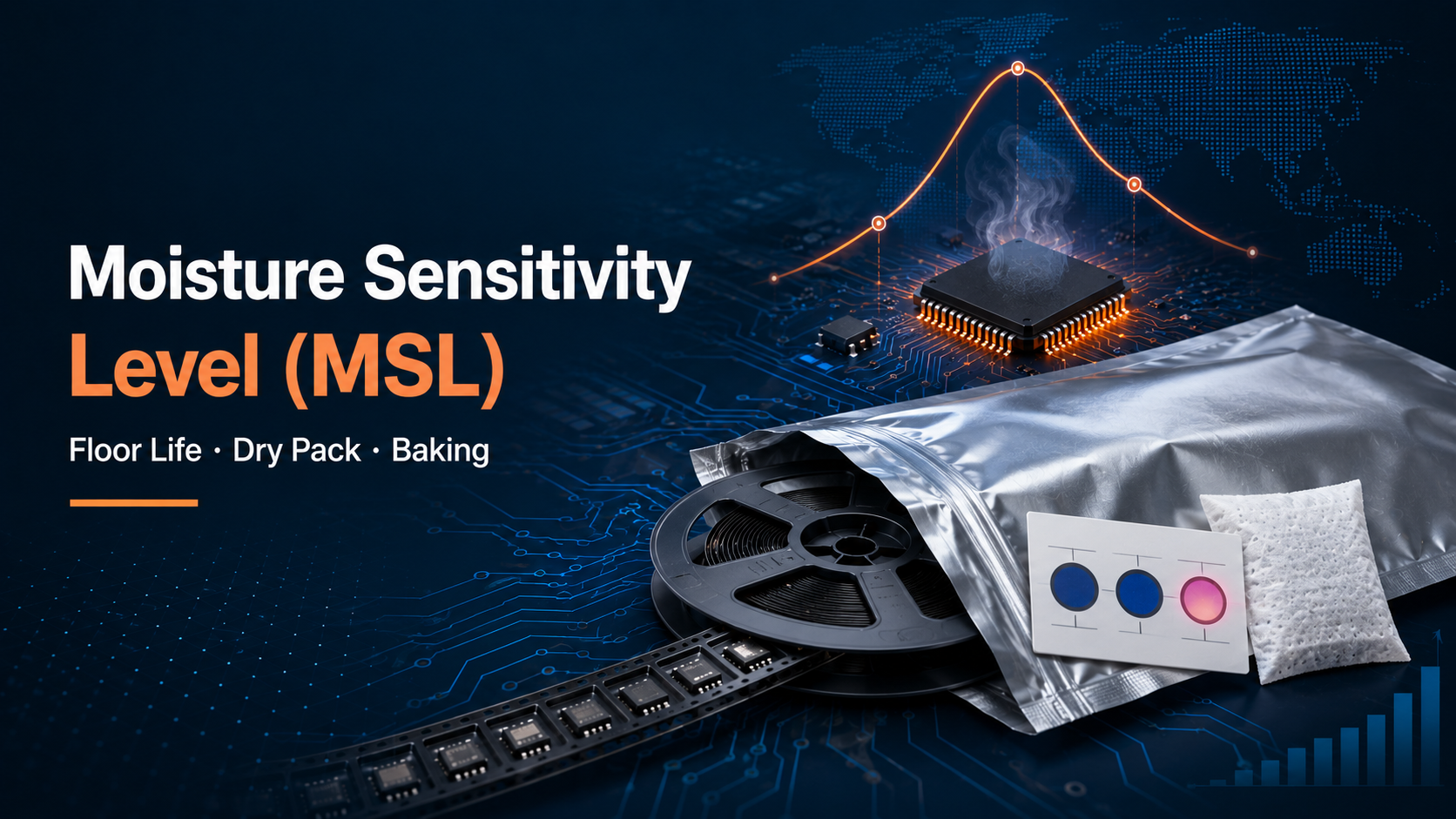
Moisture sensitivity level (MSL) is a JEDEC classification that tells you how long a surface-mount component may sit exposed to normal factory air before it must be reflow soldered. It is defined by IPC/JEDEC J-STD-020 and the handling rules are set by J-STD-033. An MSL 3 part, for example, has a floor life of 168 hours at 30 C and 60% relative humidity. Exceed that window and trapped moisture can flash to steam during reflow, cracking the package from the inside. The industry calls this popcorning.
Most guides on this subject are written for the assembly line. This one is written for the person buying the parts, because by the time a moisture-sensitive device reaches your reflow oven, most of the damage risk has already been decided by how it was packed, stored and shipped.
Why moisture sensitivity matters before assembly, not just during it
Plastic component packages are hygroscopic. The moulding compound absorbs ambient water vapour slowly and continuously. Nothing visible happens until reflow, when the part goes from room temperature to roughly 245-260 C in under two minutes. Absorbed moisture turns to vapour and expands violently.
The result is one of three failure modes. Internal delamination separates the die from the paddle or the moulding compound from the lead frame. Bond wires lift or crater. In the worst case the package audibly cracks, which is where the popcorning name comes from. The uncomfortable part is that delamination often causes no visible external defect at all, so the board passes optical inspection and fails months later in the field.
This is why moisture sensitivity is fundamentally a supply chain problem. The floor-life clock does not care whether the part sat in your stockroom or in a broker's warehouse. It only cares about cumulative exposure since the moisture barrier bag was opened.
The MSL levels and floor life table
J-STD-020 defines eight classifications. Floor life is measured at 30 C and 60% relative humidity unless the label states otherwise.
| MSL | Floor life at 30 C / 60% RH | Practical meaning |
|---|---|---|
| 1 | Unlimited | No dry pack needed. Store and handle normally. |
| 2 | 1 year | Dry packed, but generous handling margin. |
| 2a | 4 weeks | Comfortable for most build schedules. |
| 3 | 168 hours (7 days) | The most common level for modern ICs. |
| 4 | 72 hours (3 days) | Needs planning around the build slot. |
| 5 | 48 hours (2 days) | Open the bag only when the line is ready. |
| 5a | 24 hours | Effectively same-shift use. |
| 6 | Bake before use, always | Mandatory bake, then use within the time printed on the label. |
Two points that trip buyers up. First, the clock is cumulative: if a bag is opened for two days, resealed with fresh desiccant and opened again later, those two days are already spent. Second, MSL 6 is not a storage rating at all. It means the part must be baked immediately before it is used, every single time, with no exceptions.
What dry pack actually has to contain
A correctly dry-packed moisture-sensitive device arrives in a moisture barrier bag (MBB) containing three things beyond the parts themselves.
- Desiccant, sized to the bag volume and the parts inside it. A token sachet in a large bag is not compliant.
- A humidity indicator card (HIC), visible without opening the bag.
- An MSL caution label stating the level, the bag seal date, and the required bake conditions if the bag is compromised.
The HIC is the single most useful thing on an incoming shipment, and it is the one most often ignored. Modern cobalt-free cards show spots at 5%, 10% and 60% relative humidity. Read the card against J-STD-033 as follows: if the 10% spot is pink, the parts have been exposed and require a bake before use. If only the 5% spot has changed, the parts are generally still within specification. A card that is entirely blue on arrival tells you the bag seal held.
If the bag arrives already slit open, resealed with tape, or with no HIC visible at all, treat the floor life as fully consumed. You cannot recover the exposure history after the fact.
Baking: the trade-off nobody mentions
Baking drives absorbed moisture back out, resetting the floor-life clock. The standard condition is 125 C, which for most body sizes takes somewhere between 4 and 48 hours depending on package thickness and how far the part has drifted out of specification. J-STD-033 gives the full matrix by body thickness and MSL.
The catch is that 125 C destroys most carrier tape and plastic reels, which are typically rated to around 40-65 C. So a high-temperature bake means removing parts from the tape and reel first, which costs time, risks handling damage, and on fine-pitch parts is genuinely not trivial.
The alternative is a low-temperature bake at about 40 C and under 5% relative humidity, which reels usually survive. It is far slower, often several hundred hours for a badly exposed part, but it avoids repackaging entirely. Which route makes sense depends on how many hours you have before the build, not on which is technically superior.
One warning worth stating plainly: repeated high-temperature baking accelerates oxidation of the terminations and can degrade solderability. Baking is a corrective action, not a routine step.
Goods-in checklist for moisture-sensitive devices
When moisture-sensitive parts arrive, especially from the open market or an independent distributor, run this before the parts reach stores.
- Is the MBB sealed and intact? No slits, no tape repairs, no punctures around the seal.
- Read the HIC through the bag. Record the reading. A pink 10% spot means bake before use.
- Check the bag seal date against the MSL label. A bag sealed years ago with an exhausted desiccant is a bake candidate regardless of the HIC.
- Confirm the MSL level on the label matches the datasheet for that exact part number and package. A relabelled or repacked reel is a serious red flag.
- Ask for the repack record. If the parts were repacked, who did it, when, and were fresh desiccant and a new HIC used?
- Match it to the paperwork. The certificate of conformance should trace the lot back through the chain of custody.
Items 4 and 5 matter most on hard-to-find and end-of-life parts, because those are exactly the parts most likely to have been repacked somewhere along the way. Poor dry-pack hygiene often travels with the same shipments that carry other counterfeit and authenticity risks, so the two checks belong together.
How this changes what you should ask a supplier
Most purchase orders say nothing about moisture sensitivity, which means the buyer inherits whatever handling discipline the supplier happened to apply. Three questions close that gap.
Was the original manufacturer's bag ever opened? If yes, the floor life is partly or fully consumed and you need the exposure record. If repacked, what were the conditions? Fresh desiccant, new HIC, sealed in a controlled environment under 10% RH, or someone's bench. What is the bag seal date? Desiccant has a working life; an old sealed bag is not automatically a safe bag.
A supplier who cannot answer these is telling you something useful about how they store electronic components generally.
How GlobX handles moisture-sensitive devices
GlobX is an ISO 9001 certified independent distributor based in Neu-Isenburg, Germany, supplying OEM and EMS customers across Europe since 2012. Moisture-sensitive parts are handled to J-STD-033: original dry pack is preserved wherever possible, and when repacking is genuinely necessary it is done with fresh desiccant, a new humidity indicator card and a correctly completed MSL label, with the work recorded against the lot.
Every shipment carries full traceability and a certificate of conformance, so the exposure history travels with the parts instead of being reconstructed later. That matters most on obsolete and allocated parts, where the alternative is a reel with no documented history at all. If you are sourcing hard-to-find or end-of-life components and need the dry-pack condition documented, talk to our team and we will confirm the handling status before you commit to the order.
Key takeaways
- MSL is set by J-STD-020; handling and baking rules come from J-STD-033.
- MSL 3 (168 hours) is the most common level on modern ICs. MSL 1 needs no dry pack. MSL 6 must be baked before every use.
- Floor life is cumulative and starts when the moisture barrier bag is first opened.
- The humidity indicator card is your fastest incoming check: a pink 10% spot means bake before use.
- 125 C baking is fast but destroys tape and reel. A 40 C bake preserves packaging but takes far longer.
- Ask every supplier whether the original bag was opened, how it was repacked, and when it was sealed.