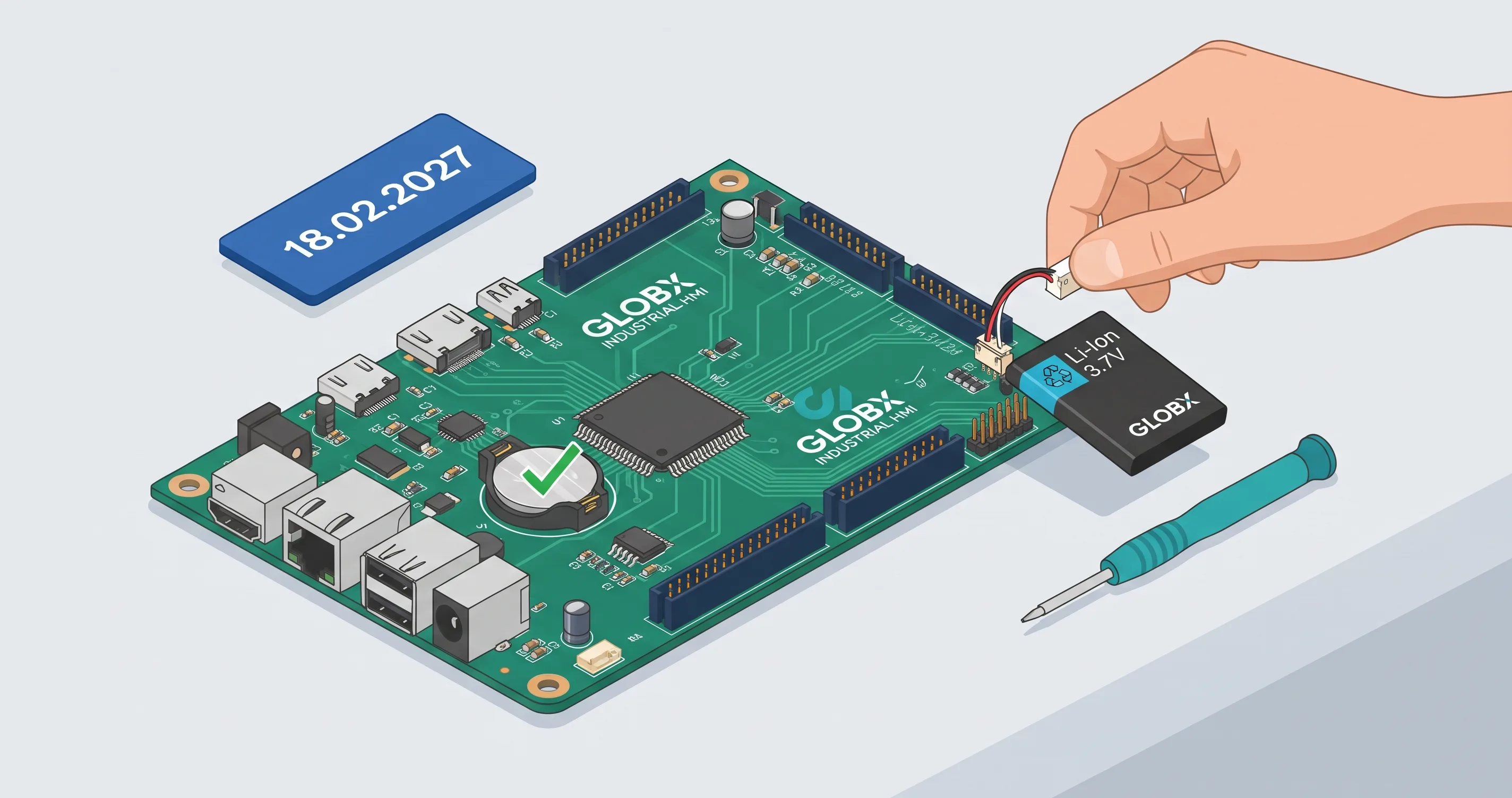
From 18 February 2027, every product placed on the EU market with a portable battery inside must let the end user remove and replace that battery with commercially available tools. Specialised tools are allowed only if they ship free with the product. Proprietary tools, heat and solvents are not allowed. This is Article 11 of the EU Batteries Regulation (EU) 2023/1542. The rule is not new, but the detail changed this autumn: the Commission updated its interpretation guidelines in July 2026, and Delegated Regulation (EU) 2026/1770, published on 22 October 2026 and in force since 11 November 2026, widened the list of products that only need professional replacement. For an electronics OEM that leaves about 12 weeks to check every battery in the BOM. Five questions sort most boards in an afternoon.
What Article 11 actually requires from 18 February 2027
Article 11 requires that a portable battery incorporated in a product can be removed and replaced by the end user, who is any adult with no repair training. The Commission's guidelines put the boundary at the toolbox. If the battery comes out with basic or commercially available tools, as classified in EN 45554, it passes. If removal needs a product-specific tool that is not supplied free, a proprietary tool, a heat gun to soften adhesive, or a solvent, it fails.
Three details from the Commission guidelines on removability and replaceability (updated spring 2026, published 14 July 2026) matter for hardware teams:
- Battery, not cell. The end-user obligation applies to the entire battery, not to individual cells inside a pack, so a multi-cell pack with one connector passes as a unit.
- A spare-parts tail. Article 11(7) adds a spare-battery obligation that outlives the product (see the FAQ below), so the replacement pack becomes a part number you must keep buying.
- No parts pairing. Article 11(8) bans software that blocks a compatible replacement battery. Serialised packs that only work after the original manufacturer re-pairs them remotely are the example the guidelines name.
The five-question BOM check
Run these five questions against every battery position in the BOM, in this order. The first "yes" decides the outcome for that battery. Each battery needs its own check because one board can carry a main pack and a backup cell with different outcomes.
- Is it a battery at all? The Regulation covers devices that deliver energy by converting chemical energy directly. An electric double-layer capacitor (supercap) holding up an RTC stores charge electrostatically, so it is not a battery under the Regulation. A product whose main job is to supply energy to other products, such as a power bank or an earbud charging case, counts as the battery itself, so Article 11 does not apply to it in the first place.
- Is the product a phone, cordless phone or slate tablet? Then stop here: the battery-replacement rules in Annex II of Ecodesign Regulation (EU) 2023/1670 take precedence over Article 11, and the assessment runs under that regulation instead.
- Does the battery only keep a clock or volatile memory alive? Article 11(3) removes the obligation where continuity of power and a permanent connection are needed for user safety or, for products whose main function is collecting and supplying data, for data integrity. The guidelines put CMOS and RTC backup batteries in processors, sensors and cameras into this derogation by name.
- Is the product on the professional-replacement list? Article 11(2), as replaced by Delegated Regulation 2026/1770, lets the battery be replaceable only by independent professionals for listed product groups. For most of them this applies only where end-user access would compromise safety.
- None of the above? Then the battery must be end-user removable from 18 February 2027, and the BOM usually changes: the connector, the holder, the fasteners and sometimes the enclosure.
The practitioner gotcha sits in question 3. The data-integrity derogation covers the backup cell. It does not cover the main battery of the same product. A battery-powered handheld meter with a soldered CR2032 for its RTC and a glued Li-ion main pack can keep the coin cell soldered, but the main pack still has to come out without heat or solvent. The guidelines also refuse the derogation where data collection is only a side feature of the product, or where the device already stores its data in non-volatile memory, so there is no data integrity at stake.
Battery role vs Article 11 outcome: a lookup table
The table maps the battery positions that turn up most often on industrial and consumer boards to their likely Article 11 outcome, based on the Regulation text, the July 2026 guidelines and Delegated Regulation 2026/1770. Treat it as triage, not legal advice. Borderline products need a documented assessment in the technical file.
| Battery position in the BOM | Likely Article 11 outcome | Typical component change |
|---|---|---|
| Coin cell backing an RTC or CMOS settings | Full derogation, Article 11(3), data integrity | None required. Record the reasoning in the technical file |
| Cell keeping battery-backed SRAM (NVSRAM) data alive | Derogation possible (battery powers volatile memory) | Optional: move data to F-RAM or EEPROM and remove the cell |
| Main Li-ion pack in a consumer or handheld device | End-user removable required | Board-to-wire connector, screwed or snap cover, spare pack for 5 years |
| Main battery in a washable appliance used in wet environments | Independent-professional replacement, Article 11(2) | Battery replaceable by professionals with commercial tools; safety evidence in the product documentation |
| Telematics unit on agricultural or construction machinery | Independent-professional replacement, 2026/1770 | Keep the pack serviceable with commercial tools |
| 10-year sealed smoke alarm cell | Full derogation, Article 11(3), safety | None, provided battery and product life match |
| Rechargeable pack in an electric toy | Independent-professional replacement until 31 July 2030, 2026/1770 | Tool-secured battery door under the toy safety rules |
The 2026/1770 list in full, according to the UL Solutions regulatory summary of 17 November 2026, covers certain water-resistant appliances and wearables, professional medical imaging and radiotherapy equipment, certain small or sealed wearables, specified electric toys with rechargeable batteries until 31 July 2030, wireless food thermometer probes, equipment for potentially explosive atmospheres, body-worn drug-delivery systems and telematics on agricultural and construction machinery.
Where the BOM changes when a battery must become removable
Making a battery end-user removable usually changes four line items: the battery termination, the retention, the enclosure fasteners and the spare-parts plan. In order of how often they bite:
- Termination. Solder-tab cells and packs with flying leads soldered to the PCB fail by definition, because desoldering is thermal energy. Replace them with a polarised board-to-wire connector or a coin-cell holder. Check the holder's retention force against your vibration profile, because a cell that pops out under vibration creates a field return.
- Retention. Adhesive is not banned by name, but any adhesive that needs heat or a solvent to release fails the test. Brackets, foam spacers or pull-tab designs that release by hand are the safe route.
- Fasteners. The guidelines expect reusable fasteners or, if they are single-use, fasteners available as spare parts. Standard Phillips or Torx screws pass. Security bits supplied only to service partners do not.
- Battery authentication. If a fuel gauge or authentication IC rejects third-party packs, the firmware must still accept a compatible battery. Safety handshakes are allowed. Lockouts are not.
Each of these changes is a new part number, so treat it like any other BOM revision: scrub the revised BOM for lifecycle status and second sources before it freezes. Check the new parts' RoHS and REACH declarations as well, because a connector or holder change resets those documents.
Worked example: an industrial HMI with two cells
Take a typical German machine-builder HMI built around an STM32H743VIT6 (9,200 units in GlobX stock, status Active, as of November 2026). The design carries two batteries:
- A soldered CR2032 on the MCU's VBAT pin, keeping the real-time clock and the 4 KB backup SRAM alive when mains power drops.
- A second soldered coin cell on an older battery-backed SRAM module that holds machine counters and calibration offsets.
Cell 1 falls squarely under the guidelines' RTC and CMOS backup wording, so it can stay soldered. The engineering team documents that reasoning in the technical file and changes nothing on the board.
Cell 2 is arguable. It powers volatile memory, which the guidelines also name, but the counters could just as well live in non-volatile memory. The cleaner fix is to remove the battery dependency altogether. A 4 Kbit SPI F-RAM such as the FM25040BG-TR (SOIC-8, 5,000 units in stock in Germany, status Active, as of November 2026) holds 512 bytes without any battery, which is enough for counters and offsets. The swap removes a cell, a holder or solder tabs, a five-year spare-battery obligation and a recurring service call. In return, the firmware needs a new SPI driver and the layout needs an 8-pin footprint. Most teams make that trade during the Article 11 revision anyway, because the board is being re-laid out already.
A 12-week plan to 18 February 2027
As of 23 November 2026 there are 87 days until Article 11 applies. Older models are not grandfathered by their launch date, so every active model is in scope. A workable sequence:
- Weeks 1-2: list every battery position across active models and run the five-question check. Record the outcome and the reasoning for each derogation claim.
- Weeks 3-6: for batteries that must become removable, select connectors, holders and fasteners. Quote them now, so that component lead times do not become the critical path in January.
- Weeks 7-10: build and test the revised boards, including vibration retention and firmware acceptance of compatible batteries.
- Weeks 11-12: update the technical file, the user instructions for battery removal and the five-year spare-battery stocking plan.
Models that cannot be revised in time have two options: ship the compliant stock before the date, or end EU sales. If the second option applies, plan a last-time buy for the parts that the revision makes obsolete. The same compliance teams are also handling the Cyber Resilience Act reporting duties, so allocate the people early.
Need connectors, coin-cell holders or battery-free F-RAM for an Article 11 revision? Send the revised BOM to GlobX and our team will confirm stock, date codes and second sources within 24 hours.