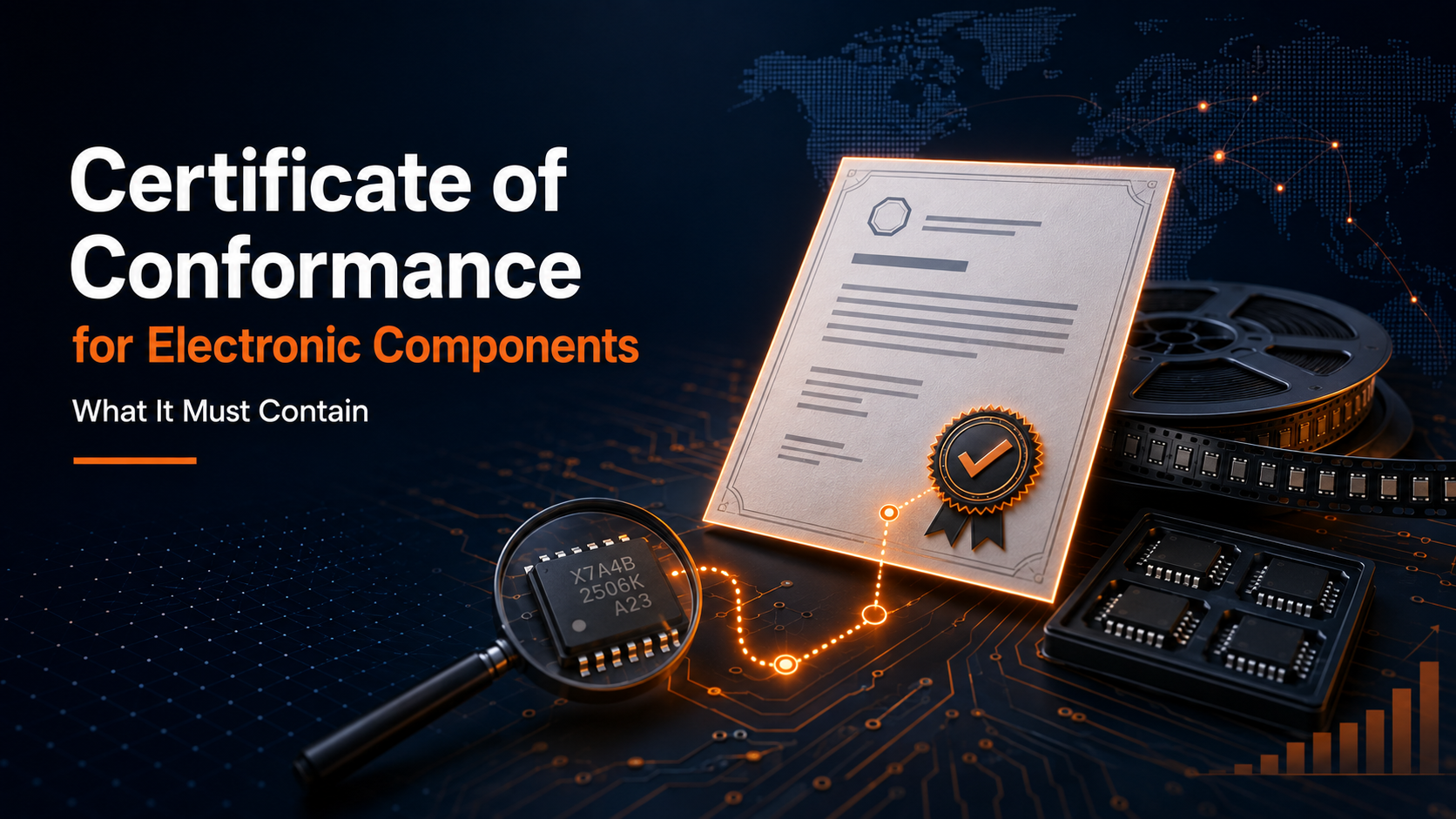
A Certificate of Conformance (CoC) is a signed declaration from a manufacturer or supplier stating that a specific batch of parts meets the agreed specification. It is the document most European buyers ask for and the one they scrutinise least. The uncomfortable truth is that a CoC issued by a distributor links a shipment to a manufacturer's claim, but on its own it does not prove traceability, and a generic one proves almost nothing at all.
This guide covers what a CoC for electronic components must actually contain, how it differs from a Certificate of Analysis and a Certificate of Origin, how to recognise a worthless or falsified certificate, and what to write into the RFQ so the paperwork is worth something when a part fails.
What a Certificate of Conformance actually is
A CoC is an attestation, not a test report. It says "this lot conforms" and is signed by someone authorised to say so. It does not normally carry measurement data, which is the single most common misunderstanding in component procurement. If you need evidence rather than assurance, a CoC is the wrong document to be asking for.
That distinction matters most on open-market buys, where the chain back to the original component manufacturer may already be broken.
CoC, CoA and Certificate of Origin: which one you need
| Document | What it asserts | Ask for it when |
|---|---|---|
| Certificate of Conformance (CoC) | The batch meets the stated specification. Attestation only, usually no data. | Routine buys where you need a documented quality claim tied to a lot. |
| Certificate of Analysis (CoA) | Actual measured results for that specific batch. | Obsolete, open-market or high-consequence parts where traceability is broken. |
| Certificate of Origin (CoO) | Country of manufacture, for customs and duty. | Import clearance, tariff classification, origin-based sourcing rules. |
| Test / inspection report | What the inspector or lab actually found and to which standard. | Whenever a CoC alone would not survive a customer audit. |
The rule of thumb: a CoC tells you what a supplier claims, a CoA and an inspection report tell you what someone measured. On a safety-critical or long-life product, ask for both.
What a CoC for electronic components must contain
Generic manufacturing CoC templates are not fit for component sourcing. A certificate you can actually rely on names all of the following:
- The exact manufacturer part number and the original component manufacturer, not just a description or an internal SKU.
- Lot codes and date codes for the physical batch being shipped, so the certificate can be matched against the parts in the box.
- Quantity and the purchase order number, linking the certificate to your specific order. Many CoCs reference only a lot number, which leaves you needing a second document to tie it back.
- The specification or standard conformed to, stated explicitly rather than as "meets all applicable requirements".
- An authorised, named signature with a date and a traceable issuer.
- The supplier's quality basis, for example ISO 9001 registration and, for open-market purchases, the AS6081 process applied.
Why a distributor CoC is not the same as traceability
This is the practitioner point that separates a working goods-in process from a filing exercise. A CoC from an independent distributor states that the distributor believes the parts conform. It can reference the original manufacturer, but it cannot manufacture a chain of custody that was already broken before the parts reached them.
Real traceability takes three things working together: documentation demanded up front in the RFQ, date and lot codes cross-referenced against the original manufacturer's own production records, and physical inspection of the parts for signs of tampering. Paperwork alone catches nothing. Inspection alone cannot tell you where a reel came from. You need both, and you need to ask for them before the order ships rather than after a failure.
This is also why the certificate matters more, not less, on obsolete and allocation buys. Those are precisely the orders where the franchised chain is unavailable, which is the same condition that makes counterfeit parts most likely to appear.
How to spot a worthless or falsified certificate
Suspect documentation tends to fail in the same predictable ways. Treat these as red flags at goods-in:
- Date codes that do not agree with the paperwork. A date code implying production after a part went end-of-life, or inconsistent codes within one reel, is the classic tell.
- No lot code, or a lot code that does not appear anywhere on the packaging. If you cannot match the certificate to the physical goods, it certifies nothing.
- Generic conformance language with no named specification, no signature, and no issuer contact details.
- A PDF that cannot be corroborated. A certificate that names an original manufacturer should survive a check against that manufacturer's published lifecycle and production data.
- Perfect paperwork on a part that is impossible to get. When a scarce, allocated device arrives with unusually clean documentation and no lead time, the documentation is the thing to doubt.
What to write into the RFQ
Documentation you did not specify is documentation you will not receive. State the requirement at quotation stage, not at delivery:
- CoC required, referencing the PO number, manufacturer part number, lot and date codes.
- Incoming inspection report for open-market purchases, to a named acceptability standard.
- CoA or independent lab test report for obsolete, allocated or safety-critical lines, following the approach in our guide to sourcing obsolete electronic components.
- Substance declarations where they apply, which is a separate obligation from conformance. See REACH compliance and RoHS compliance for what those actually require.
- The right to reject on documentation grounds alone, written into the quality agreement.
How GlobX handles documentation
GlobX is an independent distributor based in Neu-Isenburg, Germany, supplying OEM and EMS teams across Europe. Because open-market sourcing is where documentation gets thin, certificates are treated as part of the product rather than an afterthought: ISO 9001 quality management, Certificate of Conformance on shipped lots, lot and date-code traceability recorded against the order, and documented incoming inspection with escalation on anything that does not reconcile.
If a line is obsolete, allocated or simply hard to find, we tell you what level of evidence is realistically available before you commit, rather than issuing a certificate that papers over a gap. You can browse available components or read more about our sourcing and quality services.
Have a delivery whose paperwork does not add up, or a BOM line you want documented properly before it ships? Talk to the GlobX sourcing team. Quotes come back within 24 hours, shipped from Germany across the EU.
How GlobX issues CoCs in practice: see our quality process and ISO 9001/14001 certificates.