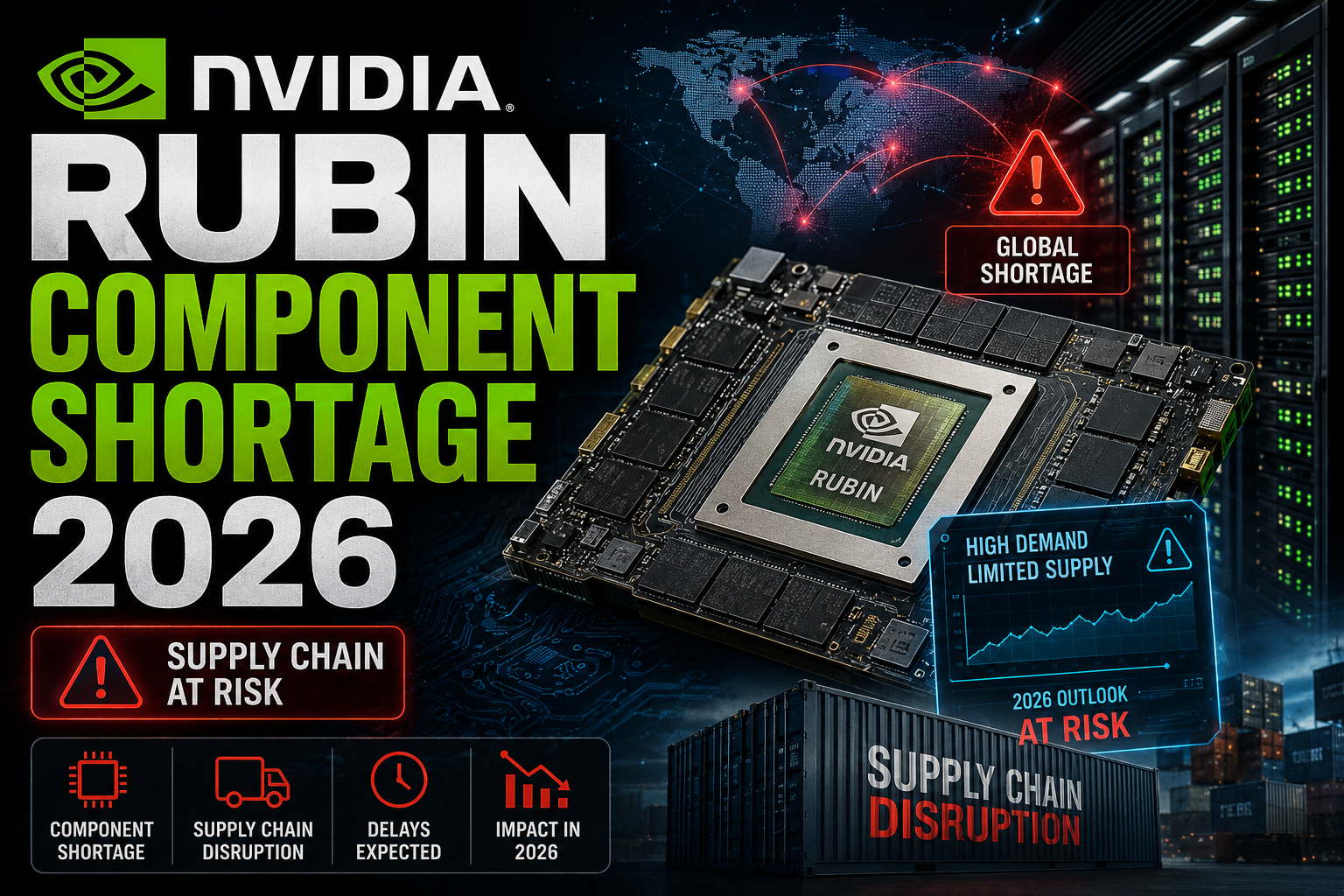
NVIDIA's new Rubin platform is the most powerful AI chip the company has ever shipped, and it is quietly rewriting the component market that every electronics buyer depends on. As Rubin ramps through 2026, it is pulling HBM4 memory, DRAM, multilayer ceramic capacitors and power-management silicon toward a handful of hyperscale data-center customers, leaving everyone else facing longer lead times, allocation-only ordering and sharp price rises. This guide explains what the Rubin chip is, who its real competitors are, which components are most exposed, and how European procurement teams can protect their bill of materials.
What is the NVIDIA Rubin chip?
NVIDIA Rubin is the successor to the Blackwell architecture and the centre of the "Vera Rubin" platform, unveiled at GTC and pushed into production through 2026, with partner systems shipping in the second half of the year. The Rubin GPU packs roughly 336 billion transistors, up to 288GB of next-generation HBM4 memory and around 22 TB/s of memory bandwidth, delivering about 50 PFLOPS of low-precision inference performance, close to five times Blackwell. It is paired with the 88-core Arm-based Vera CPU and scales into the NVL72 rack, which combines 72 Rubin GPUs and 36 Vera CPUs. The headline numbers matter to buyers for one reason: a chip this hungry for advanced memory and passives reshapes demand across the entire supply chain.
NVIDIA Rubin vs AMD MI450: the arms race that drains supply
Rubin is not arriving unopposed. AMD's Instinct MI450, built on TSMC's 2nm N2 process with up to 432GB of HBM4, is the most credible challenger NVIDIA has faced in years, and reports suggest it pushed NVIDIA to raise Rubin's memory bandwidth and power budget. Intel's Gaudi line and custom in-house silicon from the major cloud providers add further demand. For component buyers the rivalry is the problem, not the prize: two giants competing for the same scarce HBM4 stacks, advanced packaging slots and high-capacitance passives means the squeeze on supply is structural, not a passing spike.
| Spec | NVIDIA Rubin (R100) | AMD Instinct MI450 |
|---|---|---|
| Process | 3nm class | TSMC N2 (2nm) |
| Memory | Up to 288GB HBM4 | Up to 432GB HBM4 |
| Bandwidth | ~22 TB/s | ~19.6 TB/s |
| Peak (FP4) | ~50 PFLOPS | ~40 PFLOPS |
| Availability | Partner systems H2 2026 | Ramping 2026 |
Why a new AI GPU triggers a component shortage
A modern AI accelerator is not just a die. Each Rubin-class GPU needs stacks of HBM4, and the rack around it needs tens of thousands of capacitors and a dense web of power-management parts. A single next-generation GPU rack consumes between 40,000 and 60,000 MLCCs for decoupling and power filtering, and the densest current racks already require hundreds of thousands per system. To feed this, memory makers such as SK Hynix and Samsung are reallocating wafer capacity from commodity DRAM and NAND to HBM, which now absorbs a fast-growing share of total DRAM wafers. The result is a deliberate, long-term shift of capacity toward AI infrastructure, which is why analysts expect no return to normal pricing before 2027. We covered the wider pattern in our analysis of how AI is creating shortages for parts that have nothing to do with AI.
The components under pressure in 2026
The pain is concentrated in the parts Rubin and its rivals consume most. Memory leads, with DRAM prices forecast to rise 40 to 50 percent through the first half of 2026 and allocation-only ordering becoming the norm. High-capacitance MLCCs are next, with lead times that sat at 8 to 12 weeks in 2024 now stretching to 26 to 40 weeks on the grades AI servers need, and Murata, Taiyo Yuden and Samsung Electro-Mechanics all signalling price increases. Power-management and controller silicon is now being pulled in as well, as vendors prioritise higher-margin AI server output.
| Component | 2024 lead time | 2026 lead time | Pressure |
|---|---|---|---|
| HBM4 / advanced DRAM | 8-10 weeks | 20-30+ weeks, allocation | +40-50% price H1 2026 |
| High-cap MLCC | 8-12 weeks | 26-40 weeks | 6-13% price hikes |
| Commodity DRAM / NAND | stable | structurally tight | capacity diverted to HBM |
| Power-management ICs | normal | lengthening | AI-server priority |
What it means for European buyers
Most HBM production sits in South Korea and a large slice of it is pre-sold to a few American hyperscalers, which pushes smaller buyers and mid-sized European OEM and EMS firms toward the back of the allocation queue. Teams without multi-quarter contracts risk stockouts or paying steep spot prices, and first-half-2026 purchases already carry 30 to 60 percent premiums over 2024 levels. The buyers who cope best treat this as a structural shift rather than a blip, exactly the framing we set out in our guide to the 2026 semiconductor shortage for European OEMs.
A sourcing playbook for the Rubin-era shortage
- Extend your planning horizon. Shift from quarterly to annual buying for memory-intensive boards and secure 18 to 24 months of forward visibility on critical parts.
- Lock contracts and forward orders. Allocation rewards committed volume. Multi-quarter agreements beat discretionary spot buying when supply is rationed.
- Qualify second sources and alternates. Approve pin-compatible alternates and a second distributor early. Our guide to sourcing components during a shortage walks through the open-market and verified-supplier routes.
- Scrub the BOM for risk now. A structured BOM evaluation flags the long-lead and single-source parts before they stop your line.
- Buffer the right parts. Carry a 90 to 120 day buffer on the most exposed memory and high-cap MLCCs, balanced against obsolescence risk.
- Use an independent distributor for gaps. When franchised stock is on allocation, the open market and excess inventory fill the holes the authorised channel cannot.
How GlobX helps
GlobX is an independent distributor based in Neu-Isenburg near Frankfurt, sourcing the open market and a network of verified suppliers to close the gaps franchised channels leave during allocation. We are ISO 9001 certified, run anti-counterfeit inspection with full traceability and a Certificate of Conformance, and deliver across the EU with 24-hour quotes. Whether you need hard-to-find memory, high-capacitance passives or a second source for a long-lead part, our team turns Rubin-driven scarcity into a manageable purchase. Explore our sourcing and BOM services and live component availability.
Talk to the GlobX sourcing team for a 24-hour quote on the parts the AI build-out is making scarce.
The same demand wave has pushed standard memory into allocation. See our guide to the memory chip shortage 2026 for how to source DRAM, DDR4 and DDR5 when authorized channels run dry.
Frequently asked questions
What is the NVIDIA Rubin chip? NVIDIA Rubin is the AI GPU platform that succeeds Blackwell, built around a Rubin GPU with up to 288GB of HBM4 memory and the Vera CPU, ramping through 2026 with partner systems in the second half of the year.
How does NVIDIA Rubin cause a component shortage? Rubin and its rivals consume huge volumes of HBM4 memory and passives, so memory makers divert wafer capacity from commodity DRAM and NAND to HBM, tightening supply and extending lead times across the wider market.
Which components are most affected in 2026? HBM4 and advanced DRAM, high-capacitance MLCCs and power-management ICs are hit hardest, with memory lead times beyond 20 weeks and high-cap MLCCs reaching 26 to 40 weeks.
How can European buyers secure parts during the shortage? Extend planning horizons, lock multi-quarter contracts, qualify second sources and alternates, buffer the most exposed parts, and use an independent distributor such as GlobX to cover allocation gaps.
The knock-on effect reaches the parts ordinary OEMs buy: DDR5 memory modules such as the Micron MTC40F2047S1RC56BB1 sit directly in the AI build-out's demand path, and every module absorbed there tightens supply for everyone else. GlobX sources verified memory stock when franchised lead times stretch.
And the architecture race does not stop at Rubin: research labs are already working on what replaces silicon itself. Our explainer on 2D semiconductors and KAIST's contact resistance breakthrough covers the next transition on the roadmap and why every such shift eventually reshapes supply for the mature parts ordinary products depend on.
For a broader view of how AI infrastructure is tightening supply well beyond GPUs, see our 2026 semiconductor supply chain market analysis, covering foundry price increases, memory inflation, and the shift to firm capacity reservation.